Jump to a section
Somewhere around the time that I broke a wagon accessory on a tree while trying to pull it across a muddy hill with no sidewalk, I knew that we weren’t going to make it all the way to the ocean this time. The universe conspired against us on that day, not the least of everything being that I have grown to take my own advice: it’s not a race, no one wins, bail if you want. But with all the evidence that we should bail, we still wavered between surrendering to the forces against us or persevering into the night.
For those of you who ended up here and are not sure what the Great Los Angeles Walk (GLAW) is, it’s that thing where a loosely-organized group starts in one place in LA and then walks, generally down a single street for its whole length (think the major thoroughfares like Pico, Olympic, Sunset) all the way until they end. GLAW has also done some fun routes in the Valley, from Pasadena to Downtown, a route from USC to UCLA. In 2025, the route was a return to Wilshire, my personal favorite.
When I moved to LA in 2010, I tried a great many things in an effort to connect. Within a month, I was the extra on a commercial set where I met my future wife and, a few weeks after that, I met up with a bunch of like-minded Angelenos in Pershing Square to walk to the ocean. Walk organizer Michael Schneider does a good job of marketing GLAW and why he started walking. I didn’t meet any lifelong friends on that 2010 walk but I did fully fall in love with LA.
Wilshire has the entire history of the city etched in asphalt. It is beautiful, ugly, pretentious, and a celebration of living. And Wilshire is long: around 16 miles from its start as a street between 6th and 7th Streets at Grand Avenue in downtown to its end at Palisades Park, overlooking the ocean, the end greeted by an Art Deco statue of Saint Monica1. 2025 would revisit that route for the 20th anniversary of GLAW and the 15th anniversary of my journeys across the city.
What follows here isn’t everything about the journey but just some brief-ish thoughts about some of the highlights (and lowlights) of our Walk. Our journey won’t be typical of everyone’s (which is kind of the best part) so, again, if you’ve never been on the walk, don’t feel like our travails are indicative of what your journey would be like. We love it. It’s fun. And I won’t belabor the point since you can read me waxing poetic in my GLAW First Timer’s Post. But you should pencil it in for the next go-round. And feel free to skip around using the table of contents links.
Note: You'll notice that there aren't a lot of people in these pictures. That's mostly because the pictures of humans I took were of my family and I'm trying to give my kid privacy, at least in these early years. Not in a "she's a celebrity" way but in a "it feels weird to put pictures up of someone without their permission" kind of way and also in a "we live in a dastardly world right now where people's likenesses are fodder for robot education" kind of way so steel yourself for a lot of buildings and food.
Pre-amble
Our adventuring party on this trip was my wife, my daughter, my father-in-law (who came down from Washington for his second Great Walk) and me. We do not have a car on purpose and we live on the Westside. That sometimes takes a second for the horror to settle in people before I can move on so I’ll wait.
Good? On its own, getting downtown without a car can be a bit of a hassle but getting to downtown with a preschooler and a Veer wagon is not easy. Metro buses are famously difficult for people with strollers, wagons, or anything that might transport children and the city is bigger than you think, especially when you’re trying to find space for the child mobility equivalent of a tank.
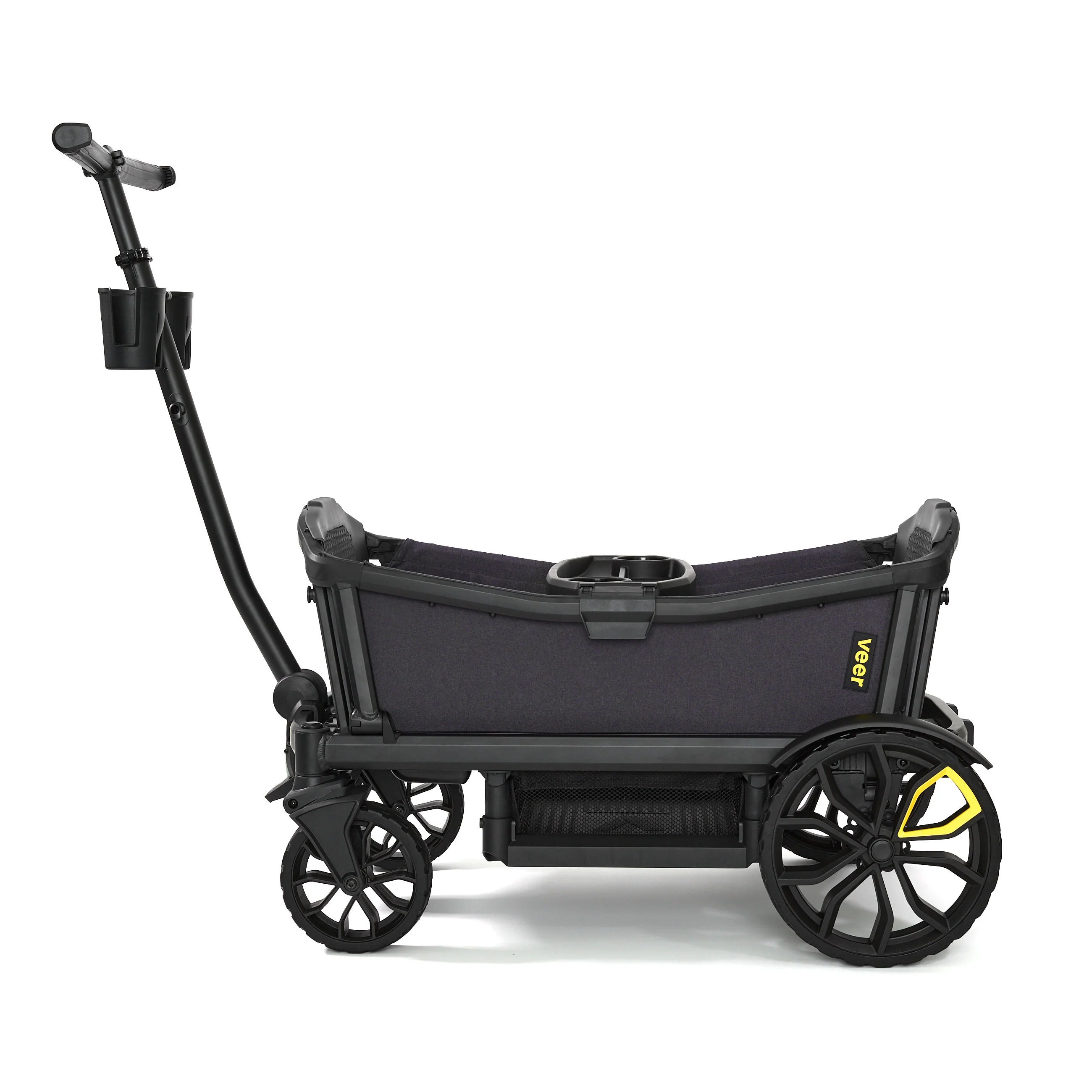
Not a sponsor but would take that money honestly.
This is the Veer All-Terrain Cruiser2. It is our workhorse, our tried-and-true, and the best thing to come out of me running the 2024 LA Marathon3 outside of the spinny Conquer LA medal (there was a coupon for 30% off items from REI in the entrant’s packet). It has traveled all across what I call the Venice Boulevard Coastal Corridor which tracks the Metro 33 from Culver City Station along Venice Boulevard (Culver City, Palms, Mar Vista, Venice, Santa Monica). This wagon already completed the 2024 Great LA Walk from USC to UCLA. It is only manageable to ferry it across town with three adults, though: grandpa carried the wheels and accessories, I carried the wagon itself, and my wife wrangled the kid.
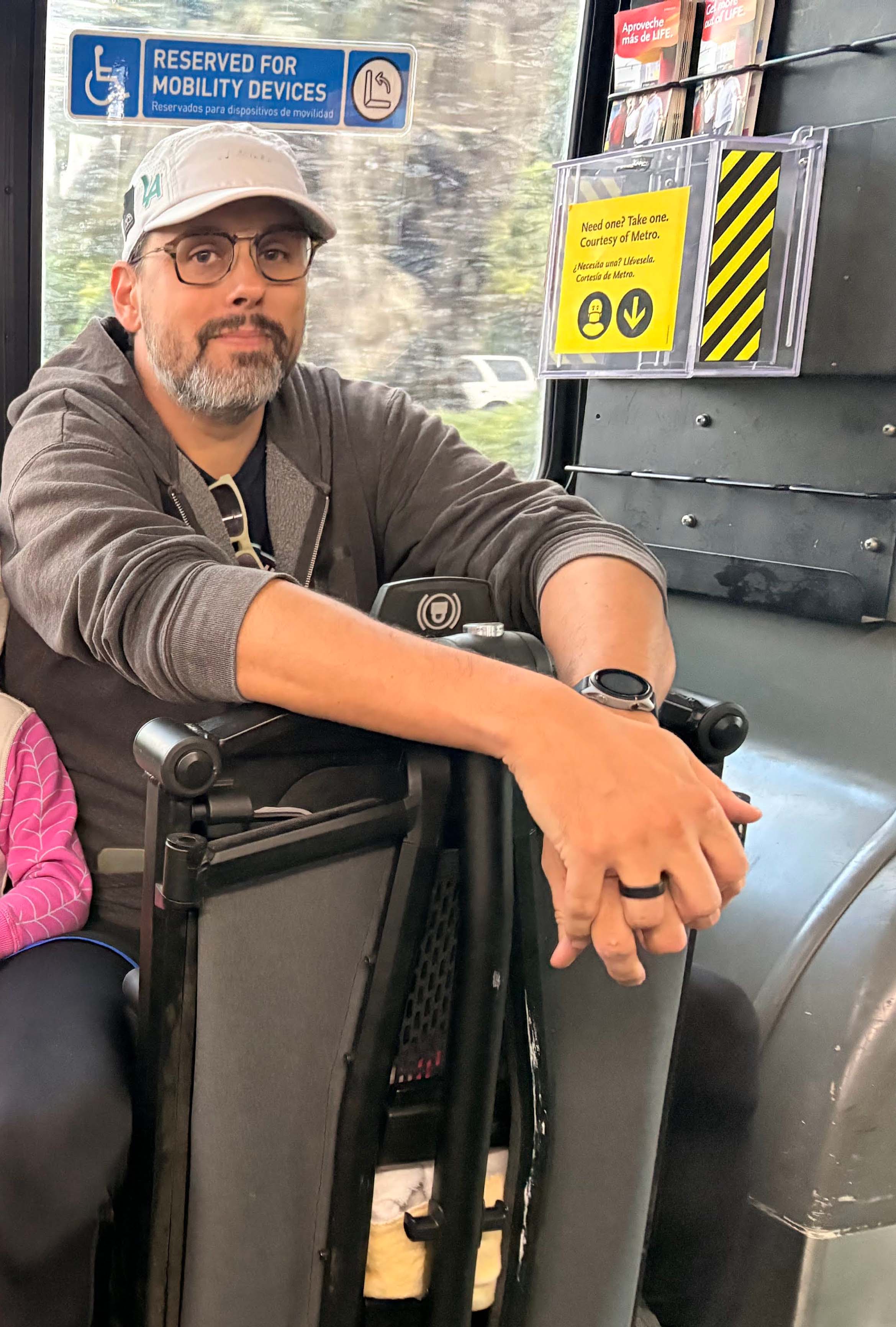
Me in an unfortunately necessary man-spread, child next to me obscured for her privacy.
After dodging the Venice Winter Fest (which we always do to go on the Walk) and scrambling our group to a more distant bus stop, we spent an hour via bus and train to arrive in a neighborhood my wife and I know well having lived in DTLA’s Historic Core in the mid-2010s (7th Street/Metro Center smells worse than I remember – at least on that day). Pershing Square, with minor improvements, is still the same all-concrete-despite-people-getting-the-bright-idea-to-make-it-grass-every-couple-years park. The kid loved the playground and the giant tree (though the tree seemed lost in the middle of the dry viaduct lake anchored by a Frankenstein-level of cobbled-together cinderblock and electrical wiring). My wife grabbed coffee and pastries from Go Get ‘Em Tiger at Grand Central Market. Hundreds of people gathered (including at least a few celebrities-in-our-household Dropout players). Michael Schneider probably said something good and encouraging (the bullhorn was bigger!). We were so far back that we didn’t actually hear it, though. People just started moving. I pressed Start Route on the app I made for this trip4. And we were off.
The Pure Chaos of Beginning or What Mobs Can Do
I’m often on record with my distaste for how much space cars and car infrastructure take up in our world. People that drive places more than they walk don’t realize how pedestrians save their lives every day. How often does someone walking on the sidewalk cede their right of way and their space to two-ton aggressors piloted by flawed human brains attending to the calculus of road variables? How often does someone walking stop on the corner and wait for a car to turn right because, already in the crosswalk, the driver is only looking left for oncoming traffic? How many times does a pedestrian feign a light jog because a car keeps creeping into the right-of-way with the eroded patience of a toddler? It’s maddening.
But then there’s the beginning of the Great LA Walk. You have a couple hundred (or more!) people that all start moving at the same time. It’s different than, say, a 5K or a parade. Those have permits and road closures and detours for cars. Here, we moved dynamically to cross the streets, fluid onto the sidewalks and crosswalks of downtown. A flood, a wave, a torrent of bodies crashing on the downtown infrastructure. A bit of lemming culture took the crowd at first where people held together and followed each other in a single stream contained by sidewalk capacity (as it did on the north side of 6th Street heading west to Grand). And like any fluid, it wanted to pour into places of least resistance. Normally, if a person wanted to cross the streets, most would not give themselves permission to just walk between intersections. This is something a jaywalker would do, a ne’er-do-well untethered from society and with no sense of mortal danger from the metal beasts that speed between lights. But, on that morning, we had the numbers.
As I pulled our wagon down the open sidewalk of the south side of 6th Street, people started to cross in front of cars. Then more and more. Finally a bulk of people filled the street and both sidewalks. For about twenty seconds, we effectively shut down 6th Street between Grand and Olive, cars halted as they waited for their space to clear. DTLA for that time was Disneyland or the Santa Monica Promenade: made for us to walk around in and all the other stuff would stop for us. It’s a dangerous way to think, especially for a loosely-organized walk for which the organizer insists you’re in charge of your own well-being. But for a time, people, likely a majority of whom probably drove sometime that morning, were all engaged in our most basic of transportation, realizing that we had the power, demanding and commanding a space, forcing the cars to surrender their will.
It’s powerful to realize what mobs can do. It’s scary to realize what mobs can do.
We turned the corner and there Wilshire waited, as it always has, with that print shop on the corner that seems to have been there undisturbed for a thousand years but also has an electronic marquee sign in the window.
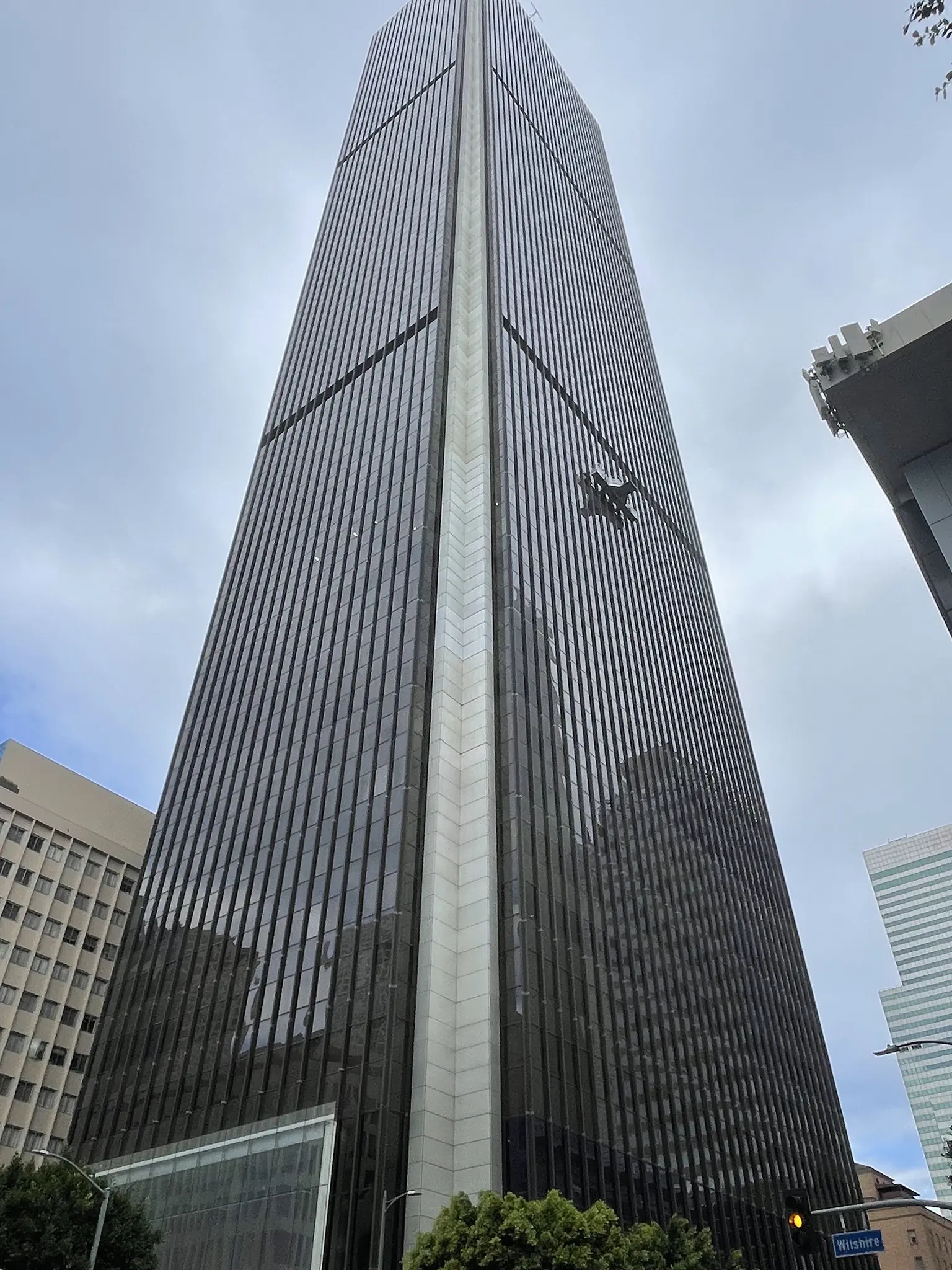
Aon Center, trying to make you ignore that it’s shorter than the building across the street.
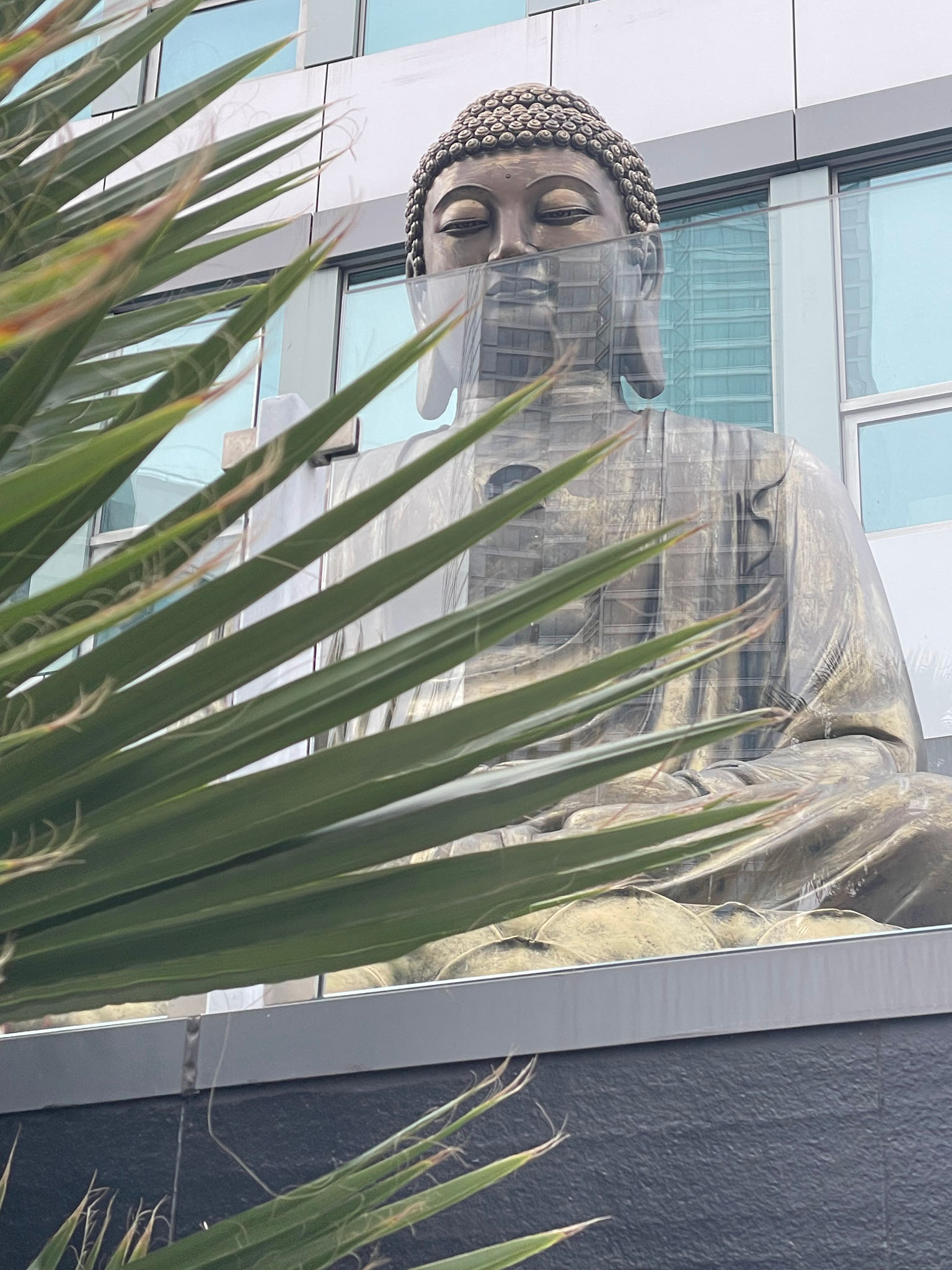
1010 Wilshire (which somehow encompasses buildings across the street from each other) nods to Sri Lankan and Korean heritages with a little peekaboo behind the leaves.
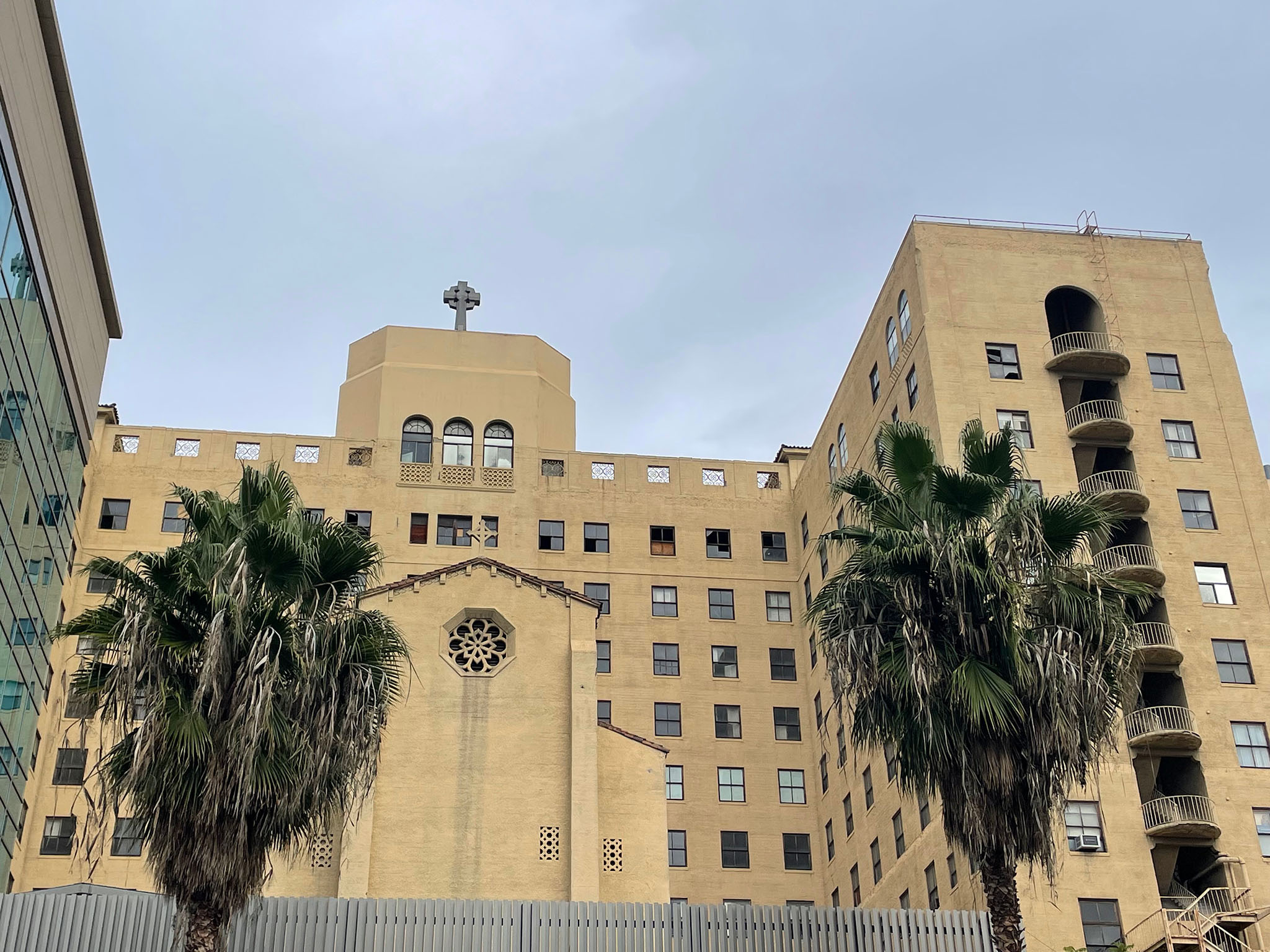
While passing by Good Samaritan Hospital, waves of people mentioned Robert F. Kennedy died in that hospital when he was assassinated in 1968. Which was then subsequently followed by monologue-worthy one-liners about current events.
The Waves of MacArthur Park
“It looks like they’re building a lot of stuff over here,” someone said as we closed in on Alvarado. “I wonder what they’re putting in the middle of the sidewalk.”
She pointed out the freestanding chainlink fence erected in the walkway. The rest of her party reacted, naturally, with shrugs. Unless you knew that this was a cheap and clunky way to deter street vendors from selling their wares yard-sale-like on the sidewalks (a tradition that goes back many decades in this area with the influx of immigration) and keeping people from finding a place to lay their heads down, this would seem odd. What would you build in the middle of the sidewalk? A green median for walkers? An art piece? Exciting innovations in concrete?
But Westlake and particularly MacArthur Park feature so many of these scrappy forms of hostile architecture, most of which rely on the tactical deployment of chainlink fence to block people from things: block off parts of the park, the tunnels, the sidewalk in a desperate plea for the “wrong” people to stop using it for the “wrong” things. Westlake is a canyon of Old Hollywood luxury in grand theaters and pricy apartments steeped in history. Raymond Chandler thought of this place as hoity-toity enough to set femme fatales here and the buildings, with their massive signs that still dominate the skies, harken back to that. Its lake is still beautiful and it can still breathe that sort of peace which our limited amount of greenspace in LA sometimes struggles to.
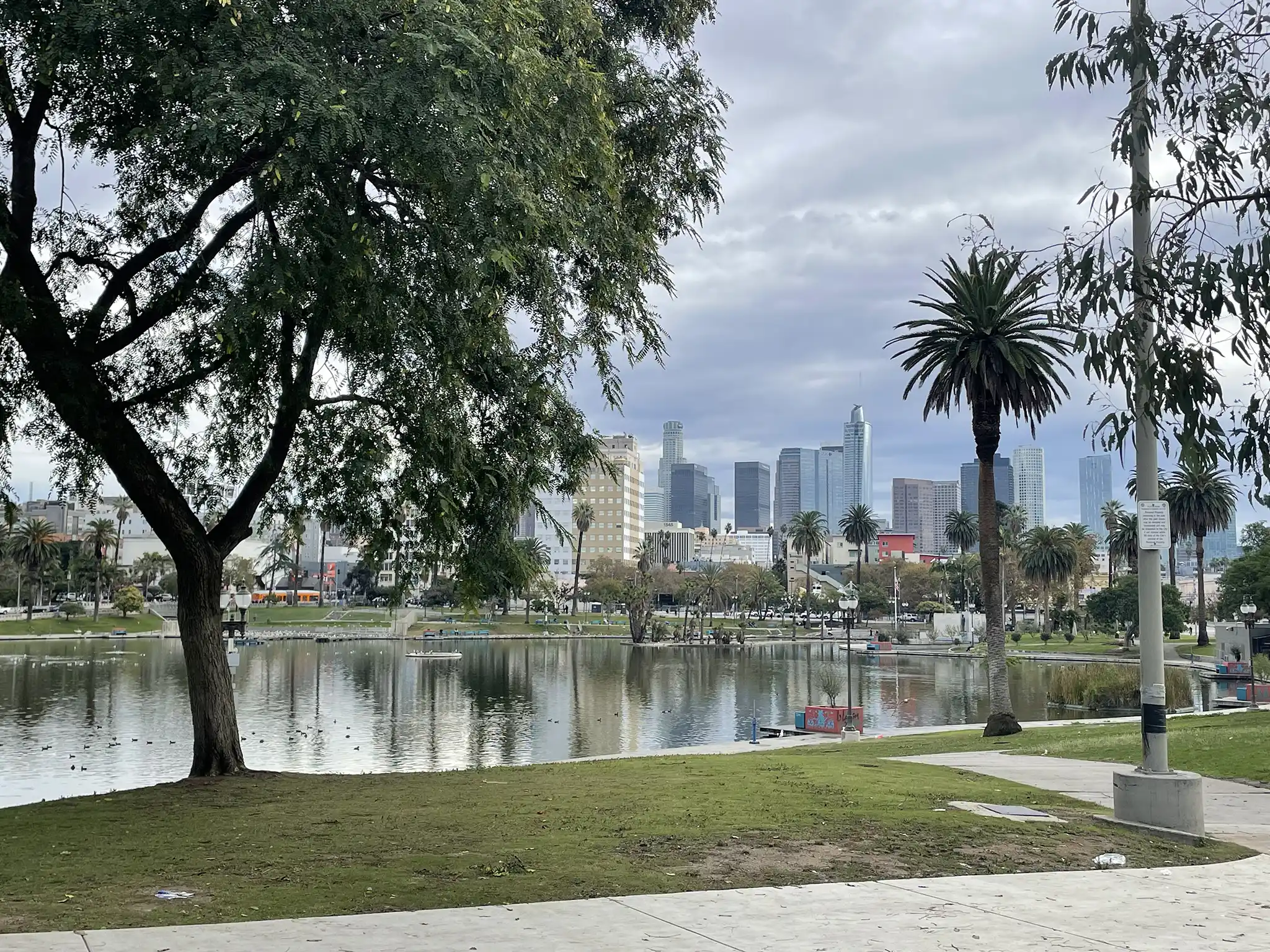
The west lake of Westlake (the East Lake is in Lincoln Park just northeast of Chinatown). Photo by George Singletary.
The city goes in cycles of attempting to make MacArthur Park work the way they want without spending Parks dollars on it. I don’t actually know that for a fact but that’s the way it seems. Instead, most of the dollars spent on it are in policing, which, honestly, is about right given the LA city budget. The claims against this park are that it’s an eyesore and a den of crime, owned by gangs. But every once in a while, its turn comes around for a sprucing. The chainlink fences come down, the bird poop is cleaned from the pathway around the lake, and grass seems a little greener. They put in a playground since the last time I was here which is pretty nice and my kid took full advantage of as we escaped the main walking crowd for about twenty minutes. I kind of wished that it was in a different part of the cycle when we showed it to my father-in-law, who, as a big fan of the song, played "MacArthur Park" on his phone as we approached. This park is still good and there’s still a lot of good on the other side of Wilshire from the lake, where kids happily played soccer and neighbors clustered together to sip coffee together.
This is probably my naivete showing. I know the crime is high in the area and the LA Times has recently reported the city wants to spend $2.3MM to put up a fence around the park to stem crime and gang activity . You walk through the gates of poverty as you walk toward the lake as people hanging around the entrance appear to literally have nowhere else to be. I want there to be a better way. I watched on TV as the federal government held an exercise in MacArthur Park where fully-armed military and military-style police marched through hills and around the lake, across playgrounds and open spaces. They found no one to steal that day but recorded enough B-roll for propaganda purposes. Angelenos, as they are with everything around these harsh measures of force from the federal government lately, hollered loudly enough that even Mayor Karen Bass, who has generally been on the wrong side or the slow side of this kind of activity in her city, reacted quickly, constructing a fully-formed press event in its wake.
LA has a time-honored tradition of surrendering its neighborhoods to spend its resources elsewhere. I imagine so many people in local government repeating the line “Forget it, Jake. It’s [insert neighborhood here]” even if they don’t say it out loud. I don’t have an answer. I just think this is a great park that has a bad reputation and bad things happening there when no one is looking. LA just doesn’t prioritize these kinds of spaces. Instead, we’re getting a glittering new convention center in downtown while Westlake gets a bunch of chainlink fence, soon wrought-iron, to inspire, not just no-goodniks, but everyone to stay away.
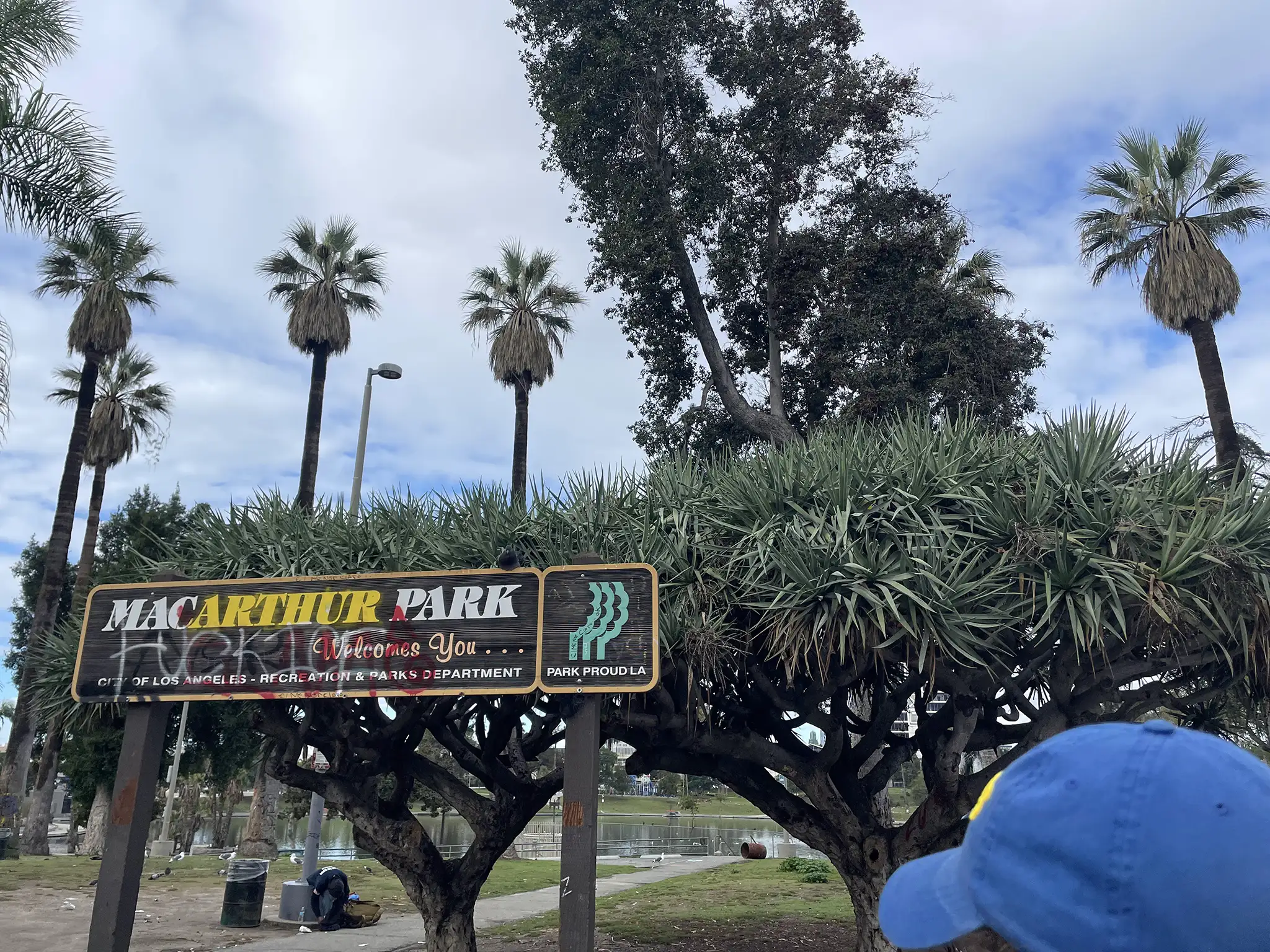
Graffiti that shouts the sentiment of so many in LA. Photo by George Singletary.
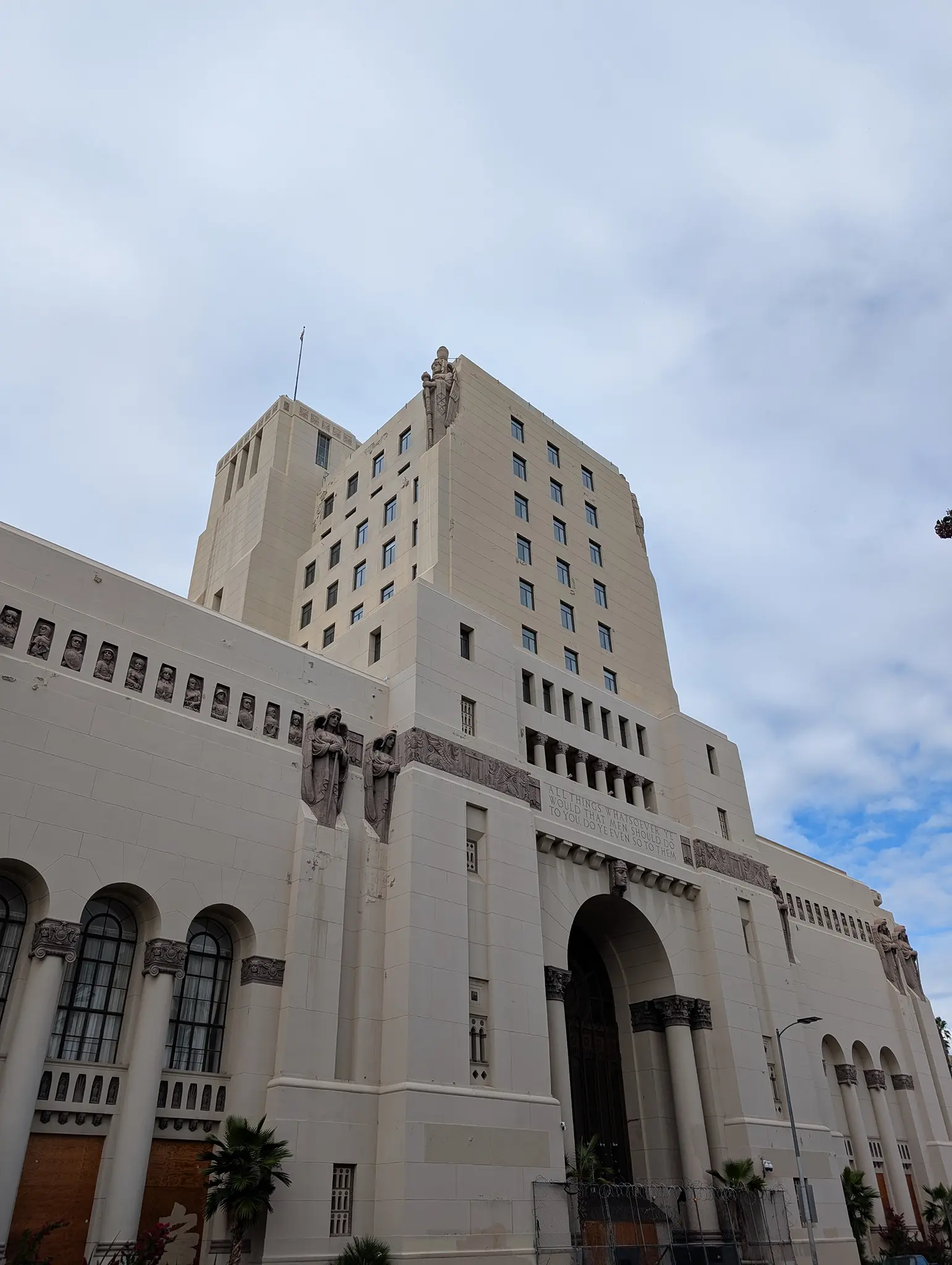
Plywood and fencing around the grand old Plaza Hotel.
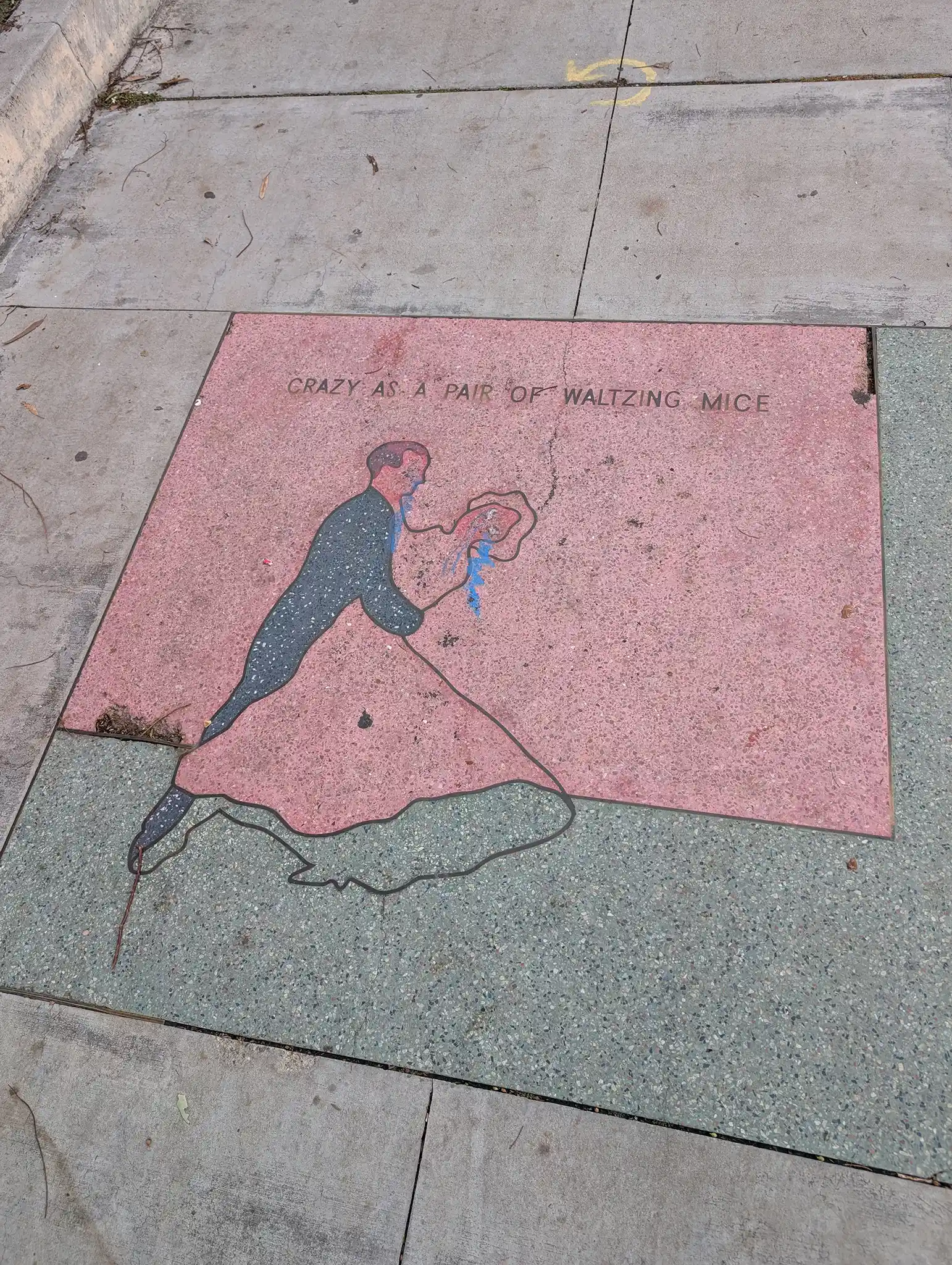
A terrazzo medallion by Alexis Smith featuring a Raymond Chandler line from Farewell, My Lovely (and other works – seems to be his favorite way to say something’s weird/strange/nonsense).
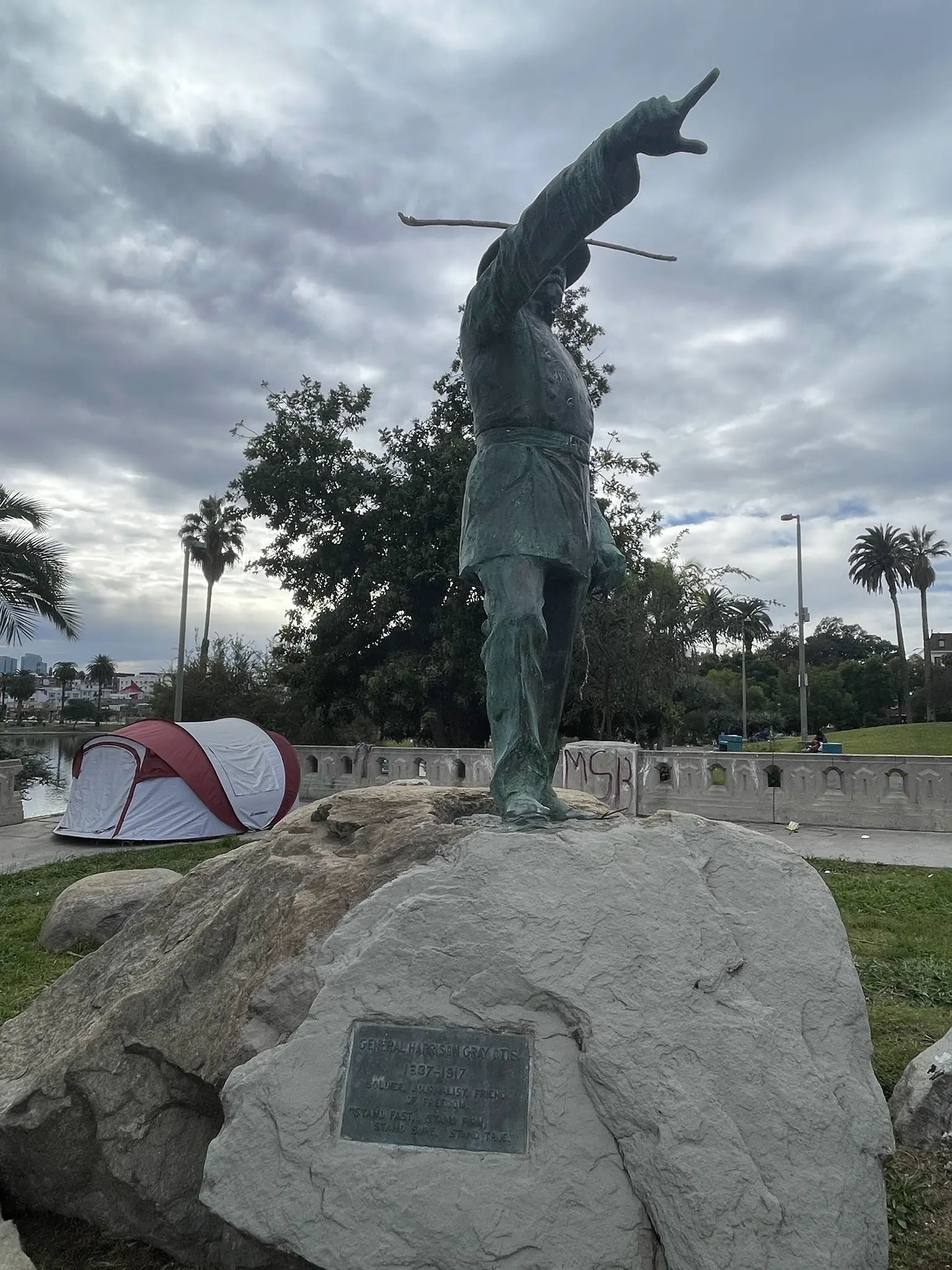
I’ve run/walked/seen this statue dozens of times and I would have put down money that this was a monument to the namesake of MacArthur Park (it’s not – this is Harrison Gray Otis, soldier and journalist known for coining the phrase, ‘You’re either with me, or against me.’).
K-Town Stomping Grounds and the Breakfast Sandwich of My Year
Thirty minutes is a long time to wait for food, especially when you’re on a walk that’s going to last at least 8 hours and you want to get to the beach by sundown. But there we were, sitting among colorful card tables stacked with glittery mahjong tiles, waiting for food, letting the lactic acid collect in our legs, just two hours into our journey, outside a place that, in a previous life, might as well have been invisible to me.
When I went on this walk the first time, I left from a termite-infested studio in Koreatown mere blocks from where we waited. My greatest regret about my time in K-Town was not being bold enough to try new things and let curiosity guide me. The bounty5 on 6th Street, Wilshire, Olympic, Western, Normandie, and Vermont could keep a foodie occupied for years. Proximity to the sweet-smelling pan dulce available in nearby Westlake. Food trucks. Gallerias. I got more confident once I met Gillian (now my wife) and we adventured into unknown territories more often. But I still think about the lost time and wasted meals ordering from Johnnie’s Pizza at Wilshire and Vermont6.
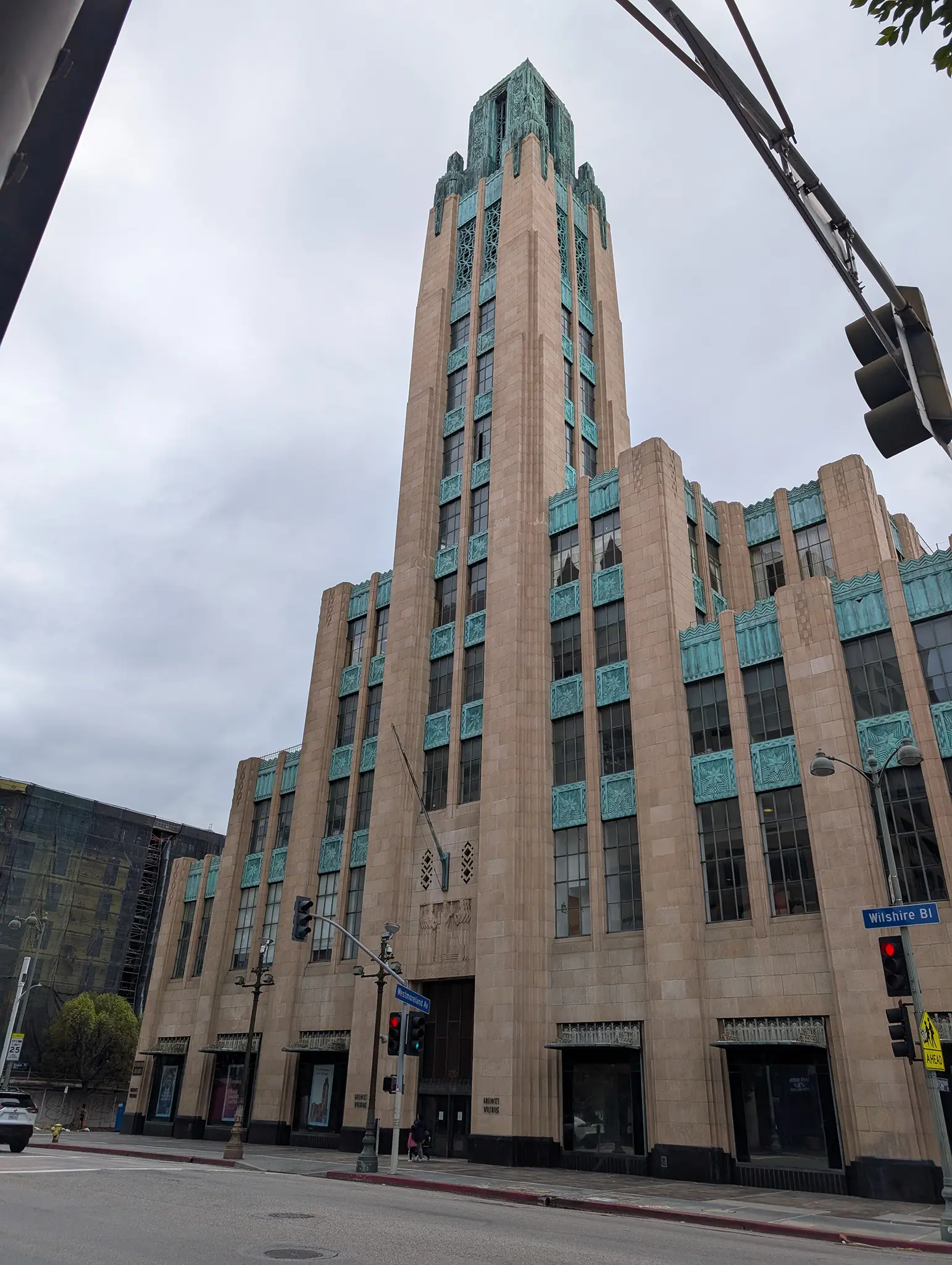
Just behind the Bullocks Wilshire is a fifth-floor apartment where I used to make quesadillas in a rice cooker.
Our daughter has visited our stomping grounds in downtown many times but this marked the first time she saw what I consider my truest introduction to LA, which also meant we hadn’t visited Koreatown since the pandemic. My list of places to try grew comically long in that span; I picture it like a scroll that rolls down stairs in a cartoon. Once we passed Hoover and saw the sign for Wilshire Center, though, all of my plans to have a crowd-pleasing circuit to food crawl 6th, Wilshire, and 7th evaporated. My stomach grumbled too loudly and urgently to make a plan. So we chose a place close and easily accessible. When I lived in the area, the space was an oft-ignored convenience store tucked between two corporate-looking buildings. That store gave way to Open Market .
Our kid leaped out of the wagon for mahjong, or, more specifically, piles of tiles which looked like toys. East Never Loses hosted an open-air set-up for people to just sign up and take a seat. None of us knew how to play (I dabbled on my PC in the 90s when I got bored with solitaire) but the people running the event seemed so very nice and were good to carefully and gently turn my five-year old away from messing with the neatly stacked sparkly tiles. And, as I mentioned, she had plenty of time to cause them trouble7.
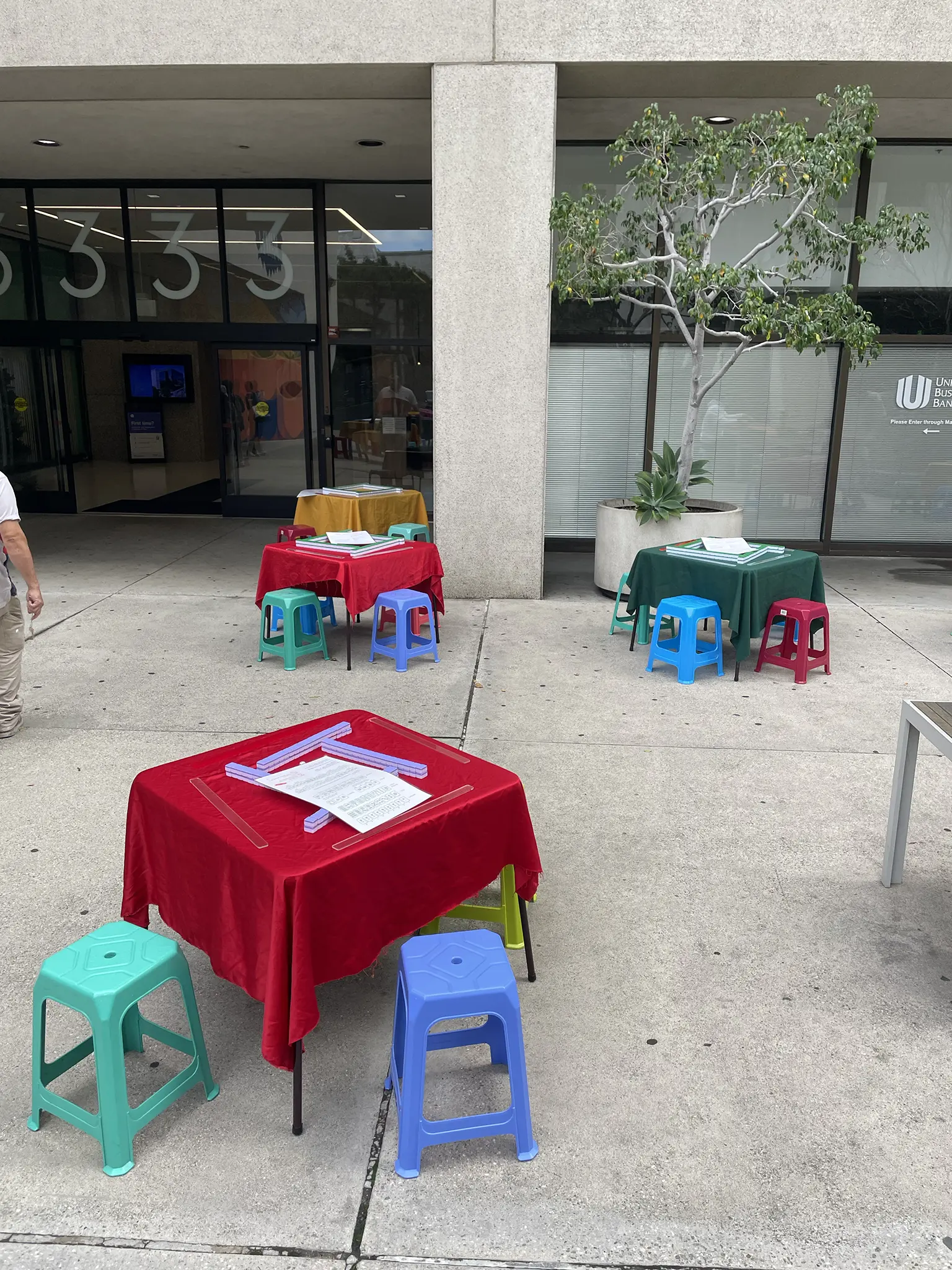
I mean, how is a five-year old NOT going to think these tables and tiles for mahjong are all toys for her?
Then the food arrived. A breakfast burrito for Gillian (and the kid to share) and a breakfast sandwich each for me and my father-in-law. There’s going to be some bias here. This breakfast was the first thing we ate since pastries in DTLA before wandering for 2-3 hours. The wait was long. But biting into it? It was easily the best breakfast sandwich I had all year.
The cheese and sausage, somehow, weren’t even the stars. Tomato jam is underrated as a condiment, having depth that ketchup could never. Arugula and fennel balanced the jam’s sweetness. And that milkbread bun melted in my mouth. But the real impressive part was the egg. A perfectly cooked egg can lift a sandwich into the troposphere and they nailed it. Even my father-in-law, usually an even-keeled, evened-enthusiasm sort of person, seemed audibly impressed. I’d forgotten until I started eating that we had a plan to only eat a little bit from many places along the way. But I was also glad to have that whole sandwich and really savor it8. My wife, a breakfast burrito connoisseur, ranked OM’s version in the top 5 in LA which is saying a lot (the kid also liked it which is maybe saying more than any of our raves).
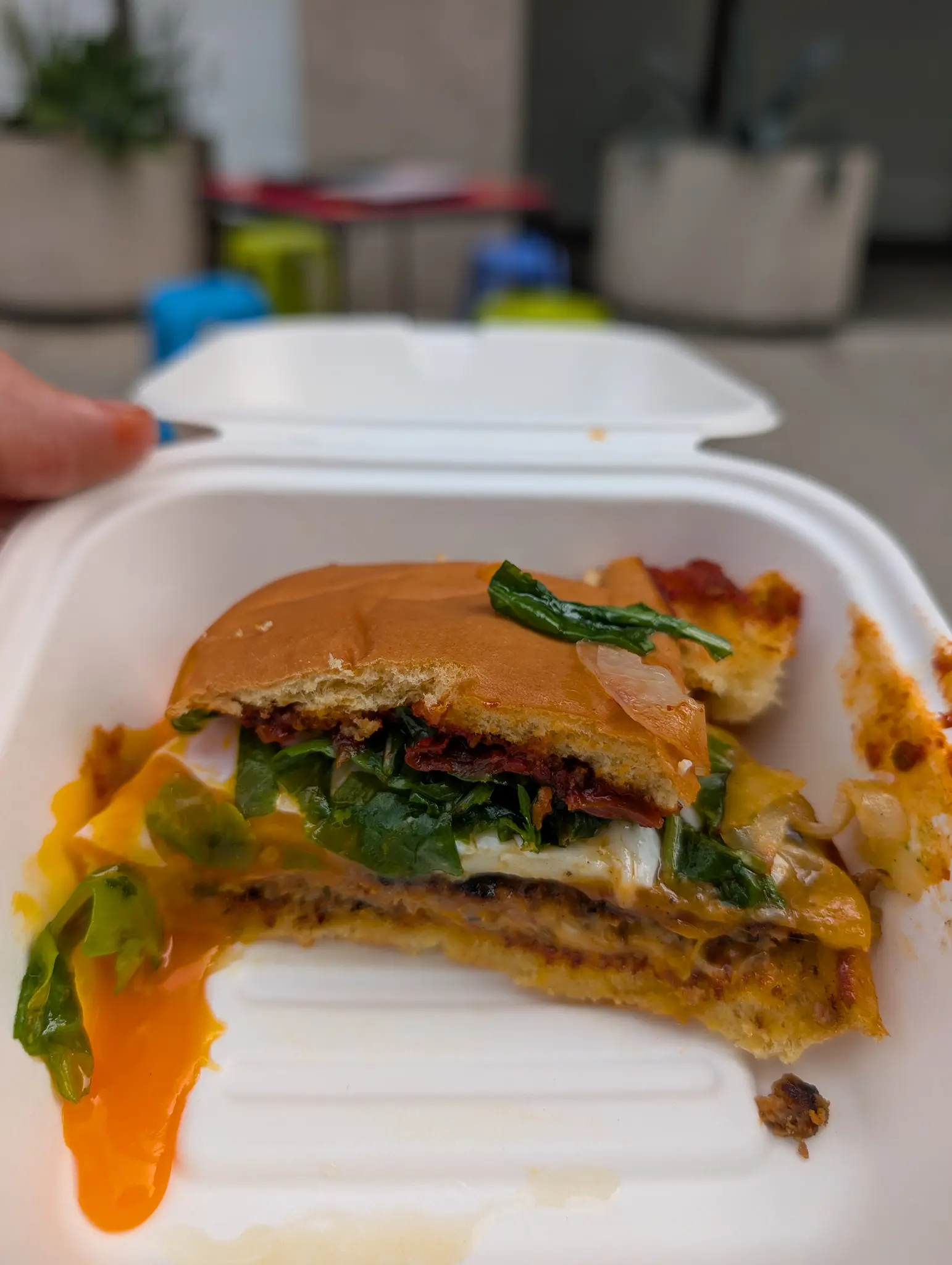
That OM breakfast sandwich cross-section tho.
This is what the Walk is ultimately about. You look at buildings. You feel the history of the neighborhoods when you slow down and engage with it outside of your cars. And you find out that LA, after all these years, still has new ways to knock your socks off.
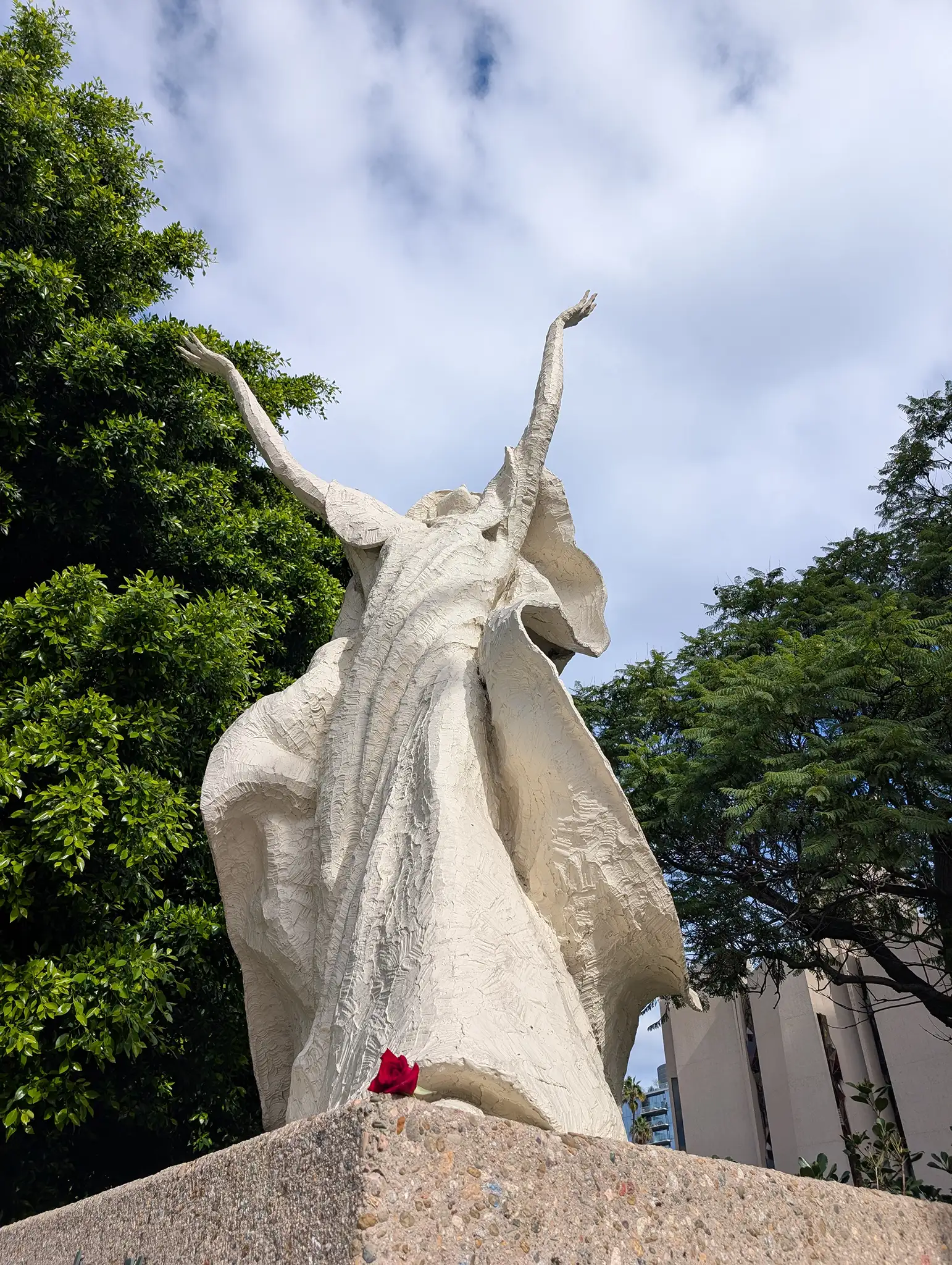
Teh drama.
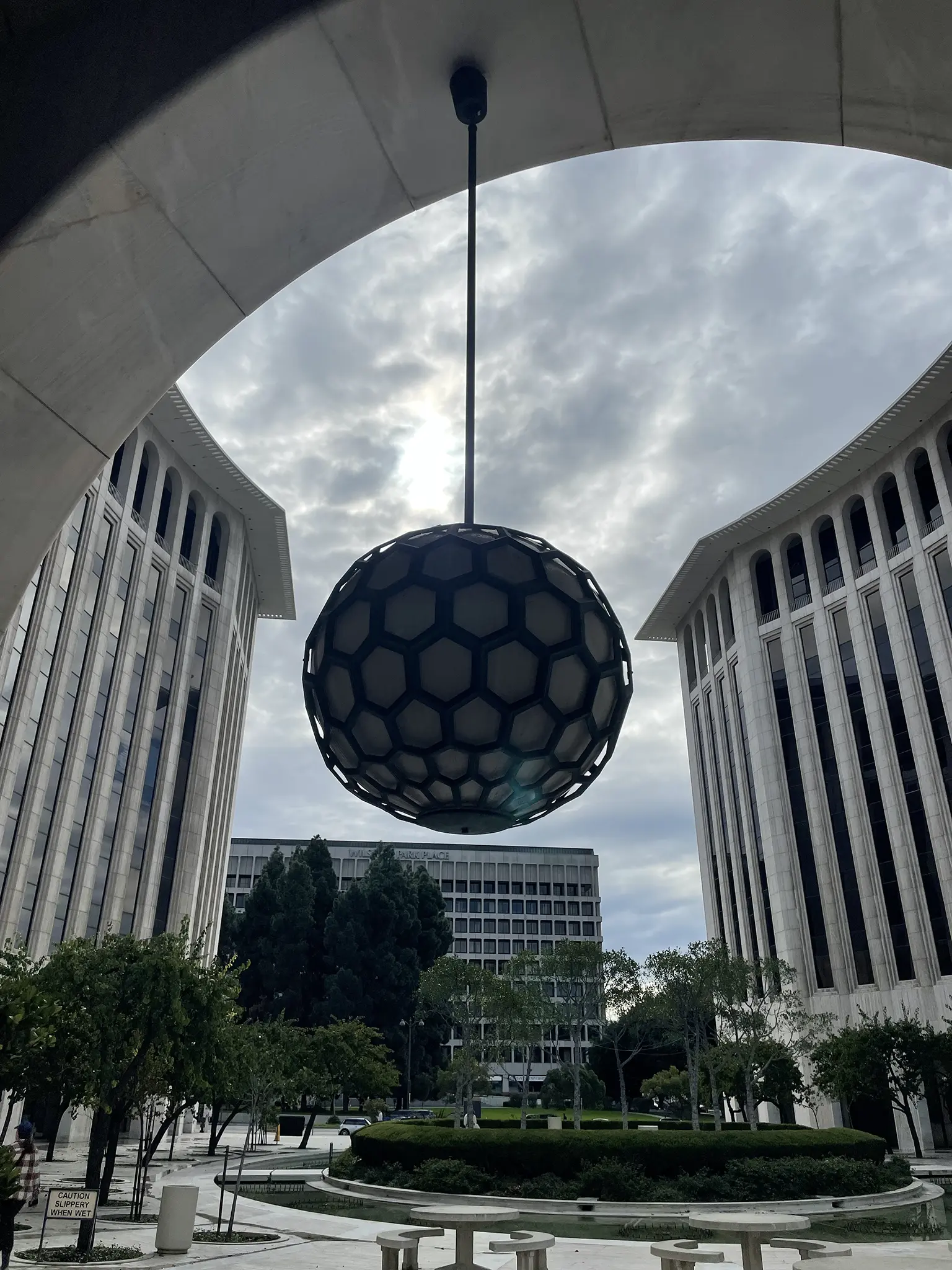
I can’t remember if it was the 2010 GLAW or the 2013 Ciclavia down Wilshire but there was somebody that I thought was a tour guide, telling everyone facts about the Wilshire Colonnade who told us that the big gap in the middle between the buildings is because they ran out of money to build. That there was supposed to be a tall building in the middle. Nothing on the internet corroborates this story and now I wonder if this is a fiction I dreamed once. But it’s all I see. Not from this angle. Photo by George Singletary.
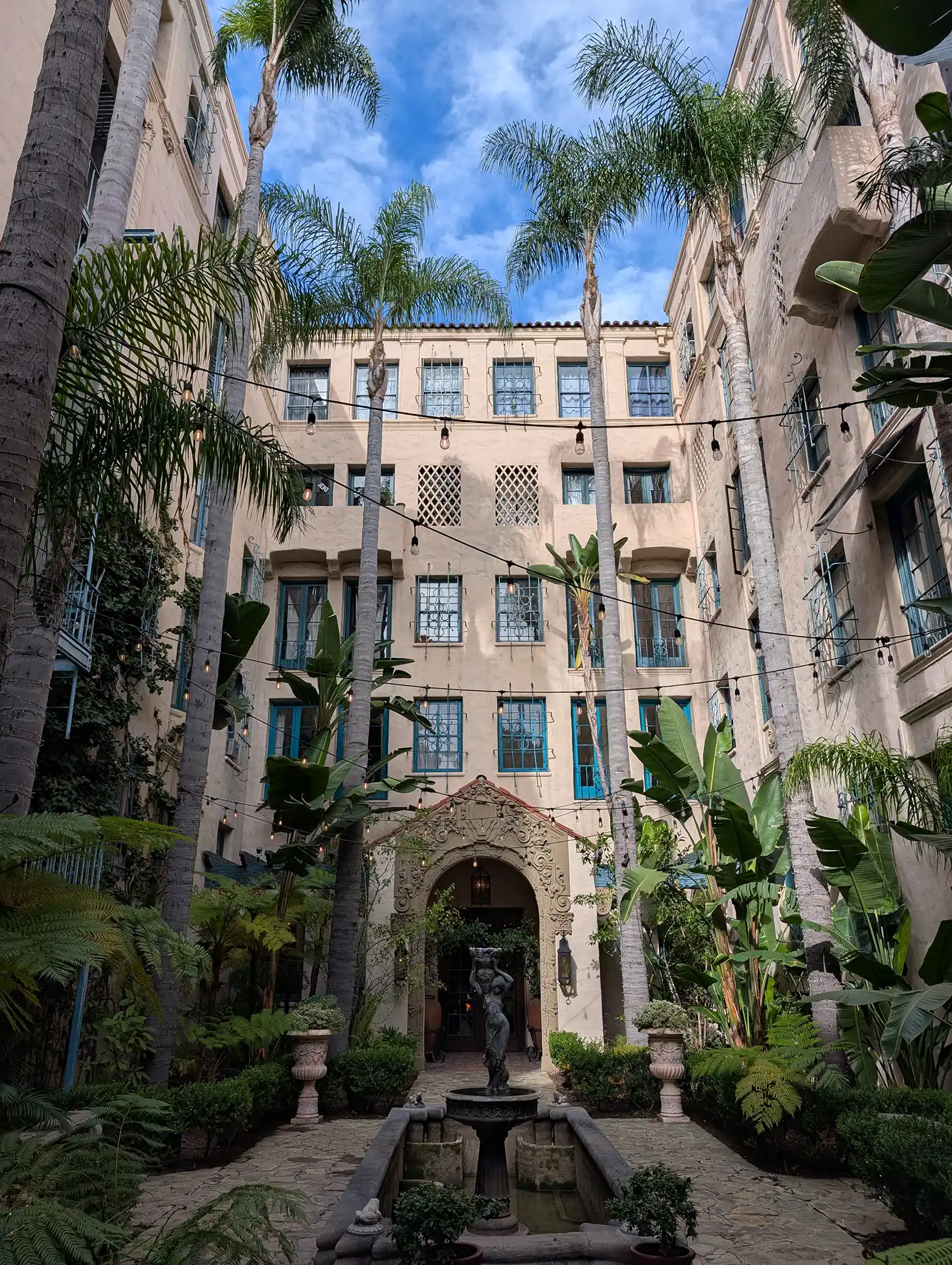
Los Altos is my if-I-were-rich aesthetic. It was also built to squirrel away (one of?) William Randolph Hearst’s mistress(es?).
The The Tar Tar Pits and Urban Light
Between Wilton and Highland, there are some interesting buildings (Scottish Rite Masonic Lodge , Ebell of Los Angeles , Farmers Insurance Building ) but not a lot in the way of things that might entertain a five-year old. There’s only so many times you can point out Moderne or Beaux Arts architecture before she gets overwhelmed by boredom. That number is one. As you might expect, this is the one and only time she fell asleep on the trip.
Happily, Highland brought with it the smell of pizza. We stopped by Apollonia’s9 and refueled before making our way toward Museum Row. Before we started the walk, I dreamed a wonderful dream where we popped into each museum for a jaunty 15-20 minutes a piece for just a hit of culture from everywhere. Then you realize, upon reaching the tar pits that you smell like a human tar pit and you’re pulling the pedestrian equivalent of a pop-up camper behind you. Not a lot of navigable space in these museums for a trailer that large. So you have to stick with what’s outside.
Our child didn’t react with the same amount of horror I did the first time I saw the brutal portrayal of mammoth tragedy in the lake of tar10 and which is for the best, really. Instead, she took a picture in front of it, all smiles with a peace sign. We didn’t go into the museum but instead wandered the grounds to let the kid run around with grandpa and watch tar seep out of the ground. My wife and I sat down for a bit and discussed what we were both thinking: we were less than three hours from a 4:45 sunset and still had 9-10 more miles to go. Even at average speed (breakneck with a wagon), we were already looking at walking through a major part of the journey without the sun.
We wound our way through the many different statues of Ice Age creatures and tar-covered traffic cones toward the Los Angeles County Museum of Art. LACMA is the museum I am most familiar with in LA. In my early days in California, hopping on the Metro 20/720 from Wilshire/Vermont meant an easy way to find some culture11. The museum campus now has buildings that snake across Wilshire in a gallery bridge but the giant plaza still felt familiar with the outdoor escalators and, of course, Urban Light aka the streetlamps in front of LACMA famously (?) in the movie Valentine’s Day.
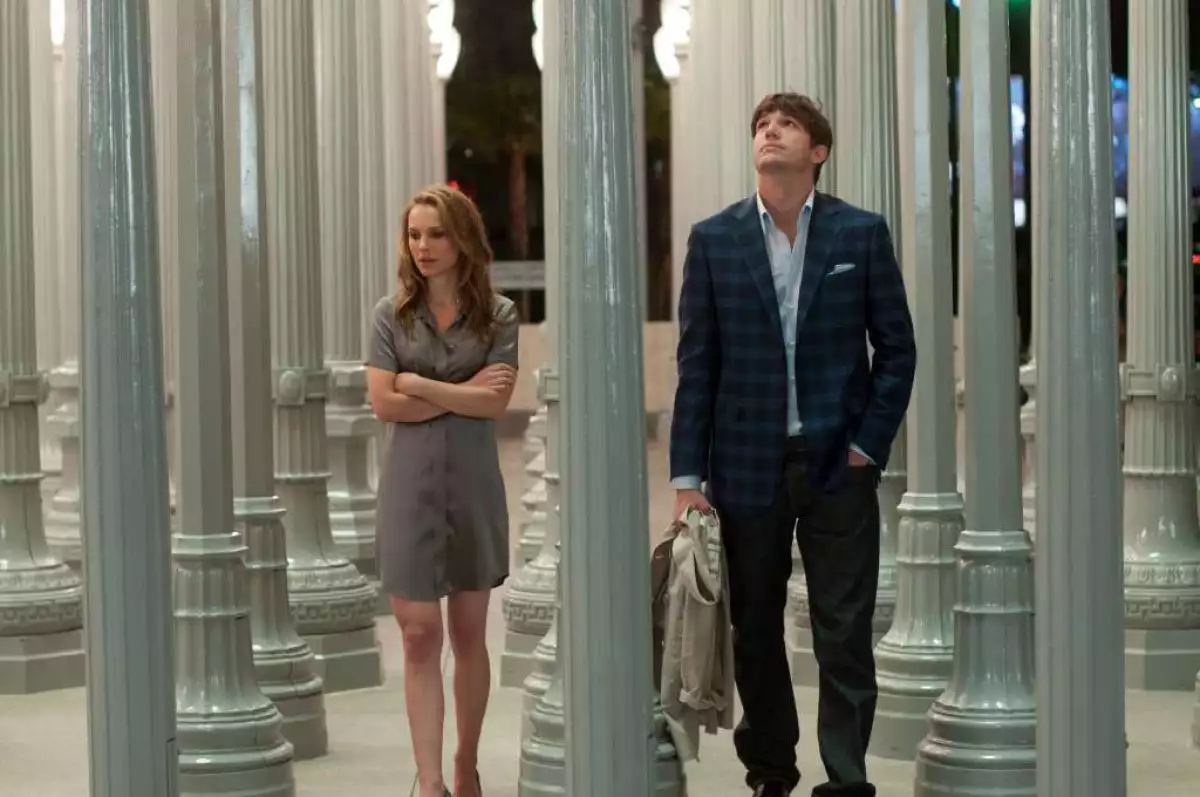
The place where Natalie Portman and Ashton Kutcher go to look sad. Photo courtesy the Los Angeles Times.
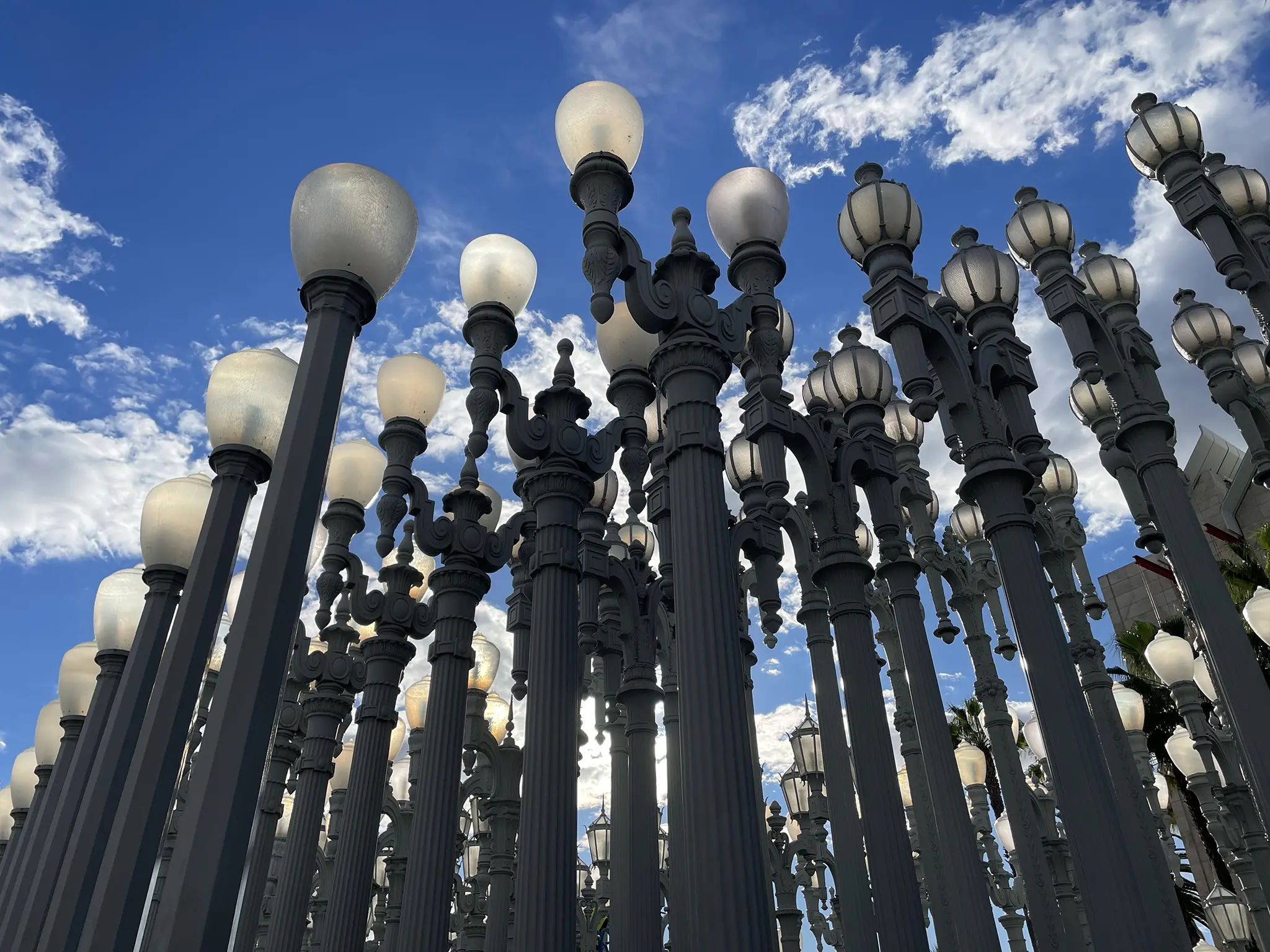
The sky and the lights. Photo by George Singletary.
When we approached Urban Light, obviously the kid hopped out quickly and raced, barefoot, down the aisles of street lamps. A woman with LACMA credentials and a binder stood next to us and said something but I couldn’t hear her since my anxiety screamed in my head, “WE’RE GOING TO GET ARRESTED FOR LETTING OUR KID RUN IN THE ART WITH NO SHOES ON.” She was a tour guide, not the child footwear police.
Her normal job was in impromptu informational tours for larger groups but many of the people hanging out around Urban Light were too distracted by taking engagement photos to listen to facts about their backdrop. So while our child fidgeted, twirled, and found mischief nearby, our own personal guide told us all about the art.
Things I learned from her:
- Chris Burden, the artist, was multi-faceted. Other demonstrations of his artistry involved being nailed to a Volkswagen through his hands (Trans-Fixed, 1974 ) and asking a friend to shoot him (Shoot, 1971 ). He also did the giant tiny-car city that’s in LACMA (Metropolis II, 2011 ).
- The lamp posts are sourced from around Southern California (and some from Oregon) and LACMA has maps for where you can see these lamp posts in the wild. She didn’t have any extra to give us (apparently they don’t print them anymore) but an old blog post has some of the zine's pages .
- There’s a smaller version of Urban Light called Light of Reason at Brandeis University in Waltham, MA.
Which I guess you could have found on the Wikipedia page but it was nice to be in front of the lights as she described the different things. We also learned about palmate and pinnate palms in her rundown of describing how frivolous and superficial plants like palm trees represent the city of Los Angeles. Everyone’s a critic.
As we headed west toward Beverly Hills, I thought a lot about the tour guide using the term “we” to describe Los Angeles as petty, superficial, and vain. That we were more about real estate than substance. It was lovingly said in that, “I can make fun of her because I love her” sort of way. But I felt like there was some distance between the thing she was saying regarding a city whose people planted a bunch of trees that provide nothing but an aesthetic and what we’d enjoyed along that journey. Good food brought about by the fusion of cultures. Architecture and art that demonstrates industriousness, innovation, and inspiration. Communities forging better worlds for generations coming up. It’s a city that certainly maintains its outward facade to the universe for everyone outside to spit on. But it’s also an incredible, multidimensional place, unbelievably massive yet inclusive, home to great minds and history. Corruption? Sure. Hollywood? It was made here. $20 smoothies from Erewhon? I mean if you’re dumb enough to buy ’em. It is all those things but it isn’t only those things. Los Angeles is full of tar pits and ways to destroy your family. But you can walk around those and what’s left is vibrancy and beautiful collisions of cultures making new cultures. Now if you could just afford a home here without multi-generational wealth.
It was 2:45 and it took 45 minutes to traverse 1000 feet but these kinds of random pleasures are what the Walk is about. Good pictures with our family. Learning something we didn’t know before. Expanding ourselves in a way that tour guides don’t quite give everyone credit for.
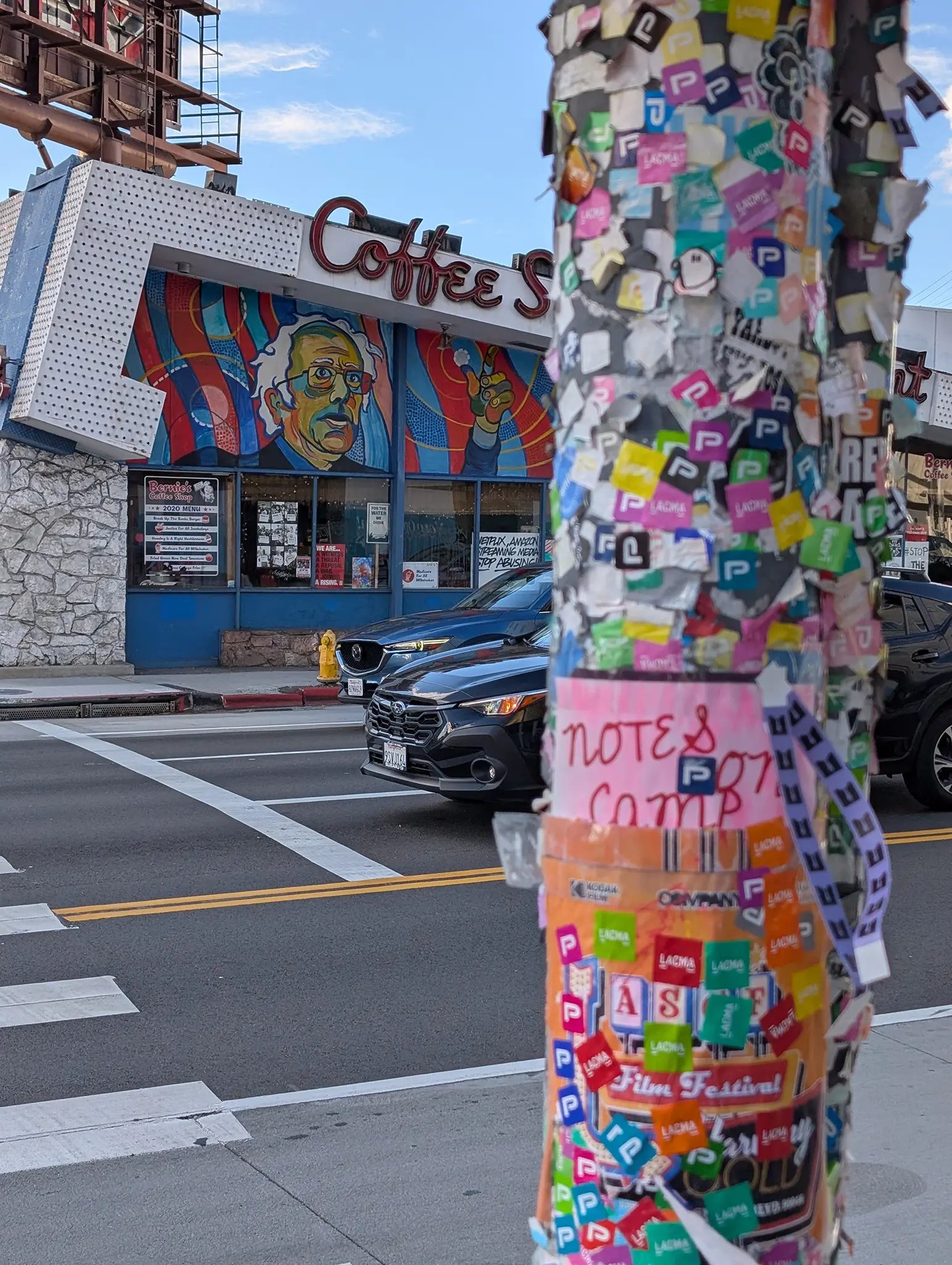
Detritus of a movement, 2016.
The Opulence and Boredom of Beverly Hills
Weezer had no effect on the kid. As we played the band’s most obvious track entering Beverly Hills 12, three adults bobbing their heads, the five-year old slumped in the wagon and begged us to do something fun for kids. A playground, a sweet treat, a bright Christmas display. Anything! Unfortunately, the path between Robertson and Rexford offered little in the ways of children’s entertainment but overflowed with office buildings, old theaters, and a statue of John Wayne13.
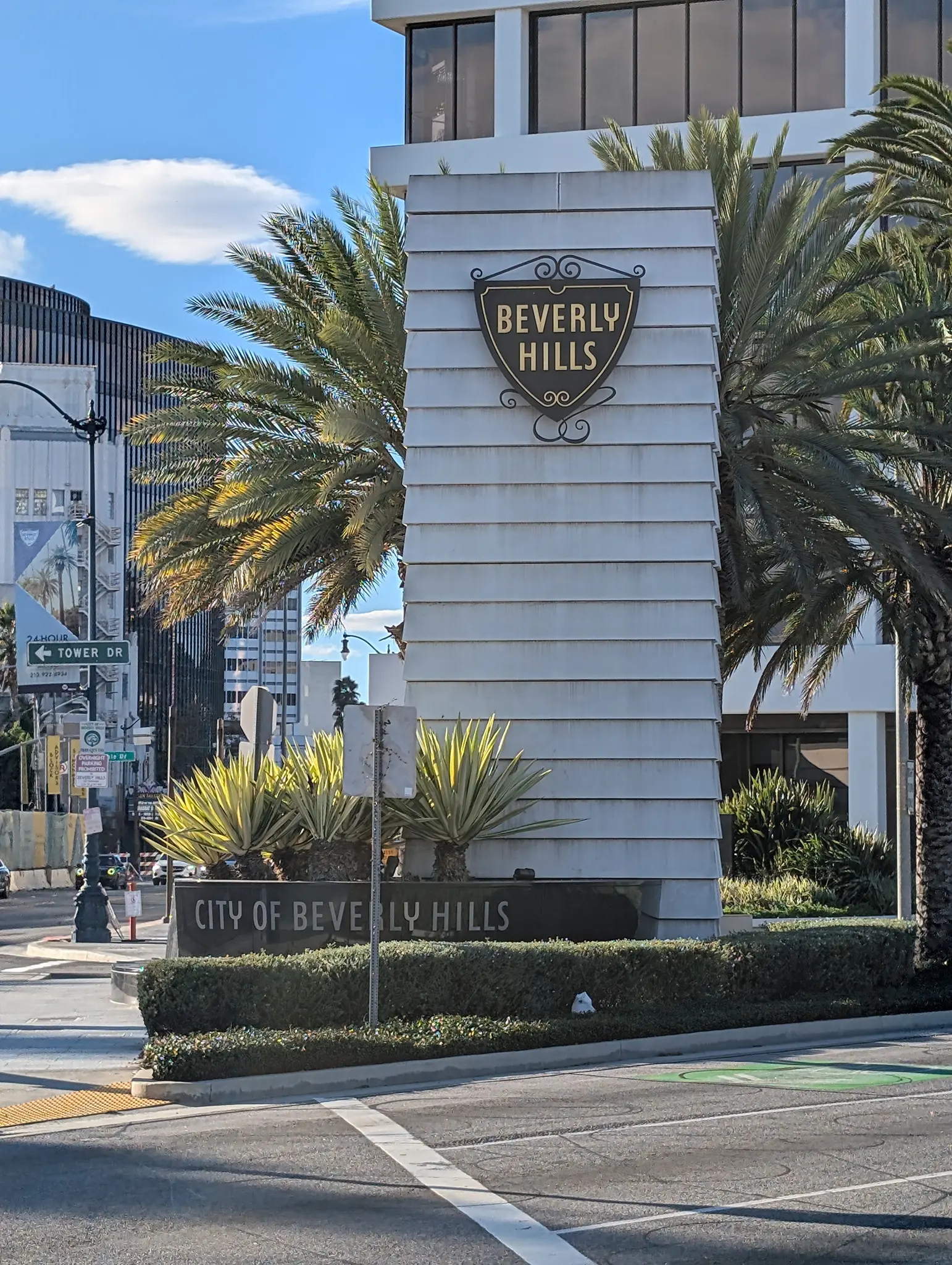
Beverly Hills. Is that where you want to be?
Things in Beverly Hills seem like they should be close enough to walk to but, even a city unto itself seems unable to avoid the sprawling problems of the region. It felt like we walked for ages past car dealerships, medical offices, and the occasional restaurant. Half a mile to a mile north and south of us were mostly houses with an unseemly distribution of fancy pools. We didn’t walk by a grocery store. We saw one CVS. I don’t remember even seeing support businesses (bars, restaurants, etc) for the theaters. Unlike other city enclaves that have maintained their independence within Los Angeles (Santa Monica, Culver, West Hollywood) which have pushed pedestrian-friendly, bicycle-inclusive, public-transit-forward agendas, Beverly Hills often chose to stand athwart history and shout “stop” for as long as they could. Cars whiz down the main arteries. Few people walk outside of the tourists and joggers.
As easy a punching bag as Beverly Hills is for its robber-baron wealth and shameless snootiness, the old theaters that remain on Wilshire are beautiful. The Saban Theatre, the Fine Arts Cinema, and the Music Hall Theatre are all still standing against the thrall of office space development, the latter of which resides in the hands of employees that refused to see it sold and wrecked (this is now the Lumiere Cinema at the Music Hall which shows arthouse fare). That’s nothing to sneeze at. But also Beverly Hills as a city has been on the wrong side of history for just about every important item of the last 100+ years14.
Reeves Park met the qualifications for the kid with a playground and a place for us to refill our water bottles. Unfortunately, the sun sank too low for us to experience the stained glass overhang of the Bank of America building near the corner of Wilshire and Beverly Drive but we did get to see one of my most vivid memories of the Walk in 2010: the steps leading up to Rodeo Drive from Wilshire, decked out for the holidays. It exudes opulence, luxury, a worship of European influence. I remember a group of people that I’d been hovering around on that first Walk while I tried to gin up the nerve to make some friends. They vanished into the ether of expensive shopping that I had no business being even in the vicinity of. I kept walking.
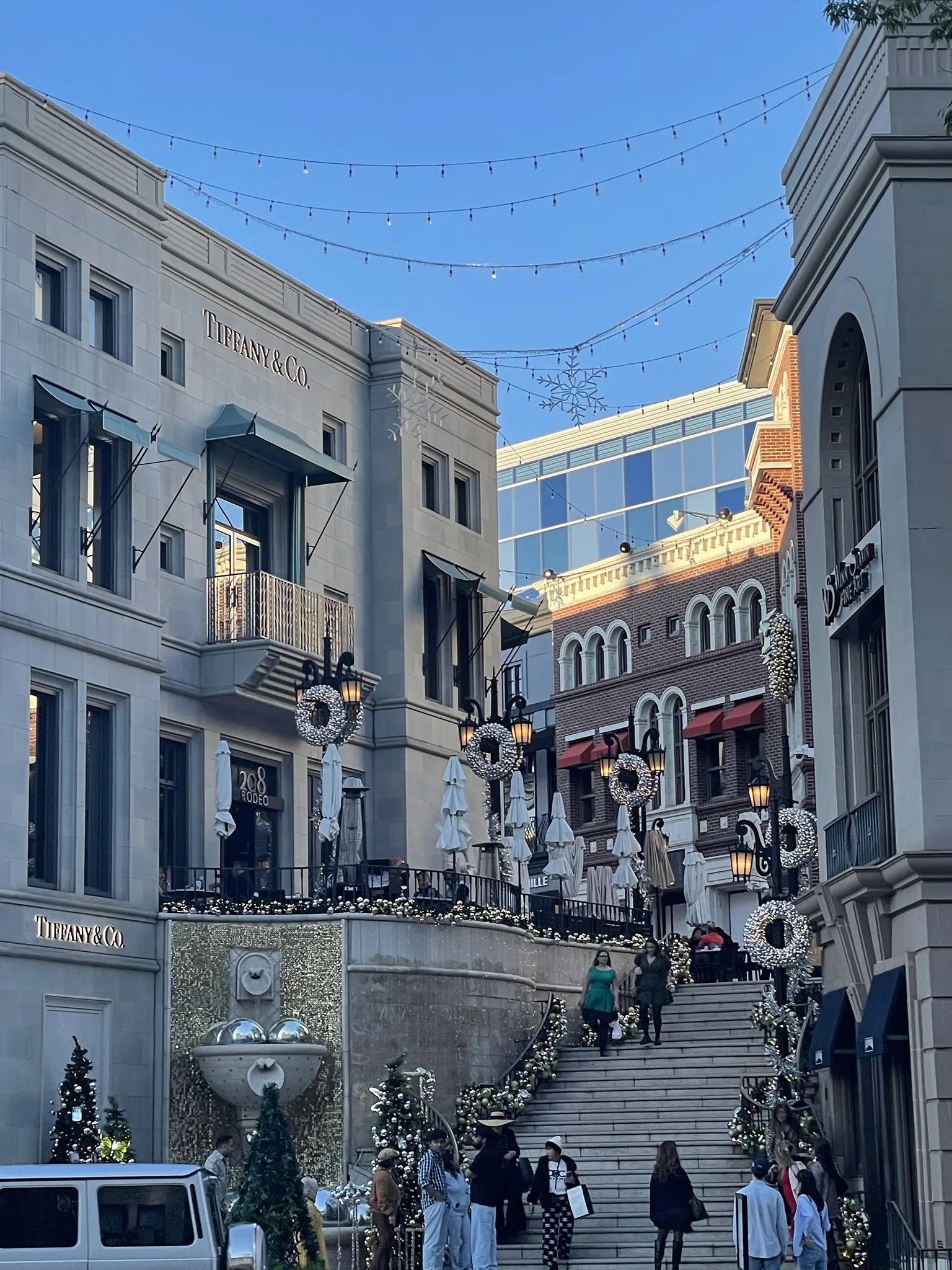
So many people wandering around wondering if they can come into enough money to tell some snooty shop clerk that they made a huge mistake not selling to them in the first place. Huge.
Beverly Hills sometimes gives me the feeling of the room in the house that’s not supposed to be touched. Like there’s a couch and furniture but it’s always roped off except for fancy guests. Hands off unless you’re worthy. Lots of high-priced art lying around as decoration. A temptation but, ultimately, boring for anyone that doesn’t feel included.
The clock struck 4. 45 minutes until sunset. Seven more miles to go.
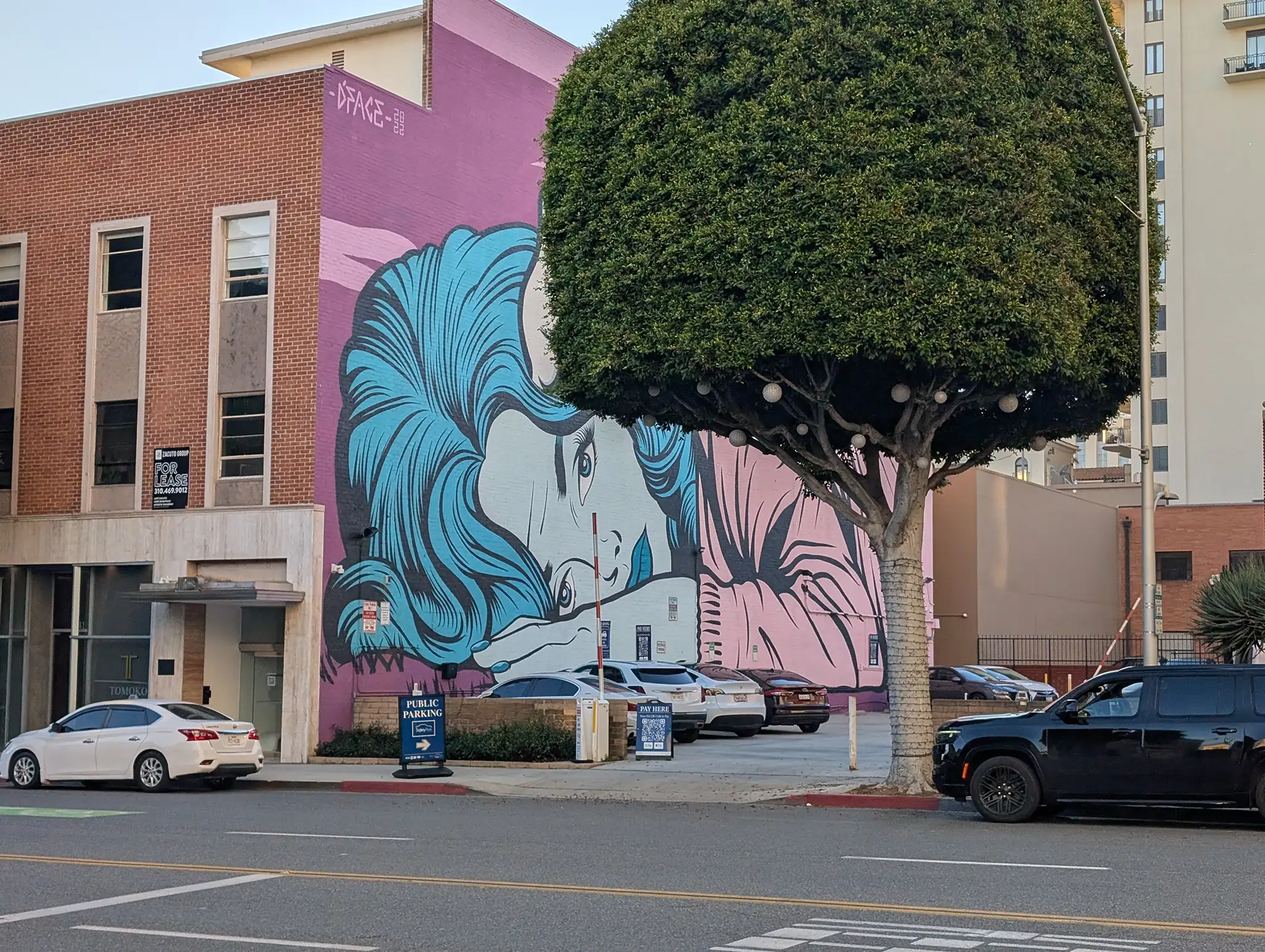
Blue for You by D*Face, 2022 (aka I Know You’re Down There)
The Mud of the Rich Tears Your Heart Out
There’s always a point in every walk where you’re done and it’s time to drive to the end. The journey turns into mustering up what you have left so you can finish. Gillian did the Walk with me for the first time in 2011 and I remember us just dying to get through Santa Monica, literally counting down the streets as we passed them. In 2024, we’d had some wild thoughts that we would get to the Hammer in time to appreciate it. By the time we got to Wilshire via Westwood Boulevard, there was no way any of us were in a place where we could stop and actually enjoy the space15. It sneaks up on you that feeling to be done with it. Suddenly, you realize that you’re walking a lot faster, noticing less, searching for cross streets that represent mile markers. You want to teleport.
The beginning of this doom started for us in 2025 with Electric Fountain, an art piece and working fountain in Beverly Hills I genuinely love (no offense, John Wayne statue). There’s something about that pensive indigenous representation on the top of the fountain, facing a town building itself up on stolen land, the thieves then making laws that only thieves like them could live there. From that point at Santa Monica Boulevard, Beverly Gardens stretches down the north side of Wilshire to create a spacious trail offset from the many-laned speedway dense with cars geared up for speed. It’s an odd bone thrown to pedestrians in an otherwise major-artery-driven city in Beverly Hills.
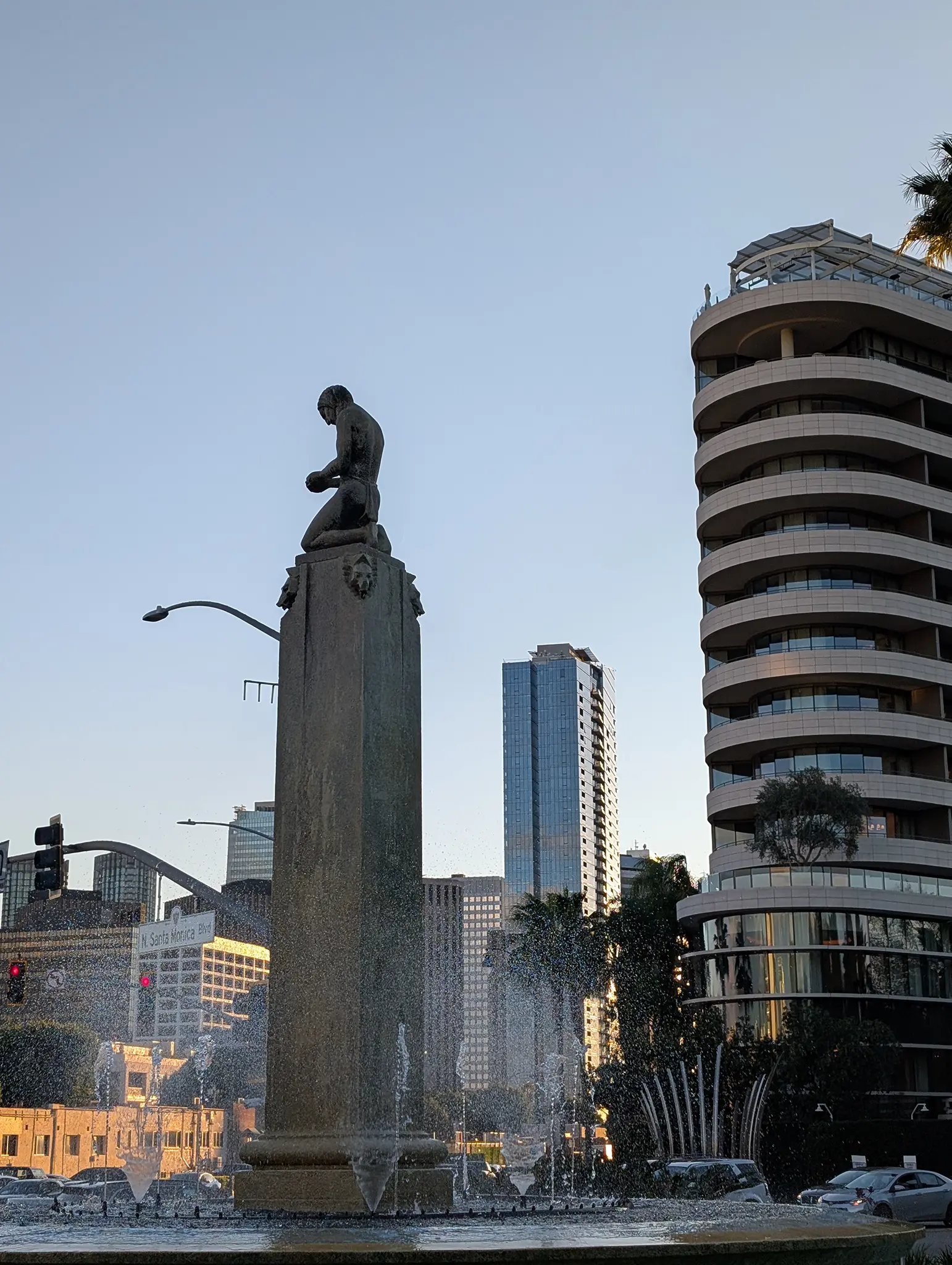
Yeah. We are the worst.
This was where my brain tore itself apart. There was signage on the left side of the street warning about construction and a pedestrian detour. On the side of the street (the side we were on), there was this tree-covered, quieter space made for walking. I felt torn.
You see, for the Wilshire walk, Michael Schneider always adds a warning to the handout. Once you cross Santa Monica Boulevard, the powers of the city allowed the sidewalk on one side of the street to vanish once you get to the Los Angeles Country Club. For the better part of a mile, Wilshire is just a cut-through to get to Westwood with nothing but high fences and a wide road to look at.
I convinced myself the handout warning must have just been human error. “Oh,” I thought, “Michael Schneider is just one person. Maybe he made a mistake and it’s the right side of the road we’re supposed to be on, not the left?” Yeah, even though he’s made this particular warning several times over the past 20 years.
Reader, this is a classic example of playing oneself.
Just after Merv Griffin Way on the south side (Whittier on the north) there is an unannounced end of sidewalk and then just dirt16. A narrow shoulder of trees, scrub brush, and mostly earth between dust and mud stages formed a small hill leading from the tall fences of the country club into the street. I watched, embarrassed, that I knew the answer to our dilemma before it started, that with the information I had, I could have encouraged us to cross the street. I recognized a desire path in front of us, trodden no doubt by other pedestrians who saw this travesty of infrastructure and attempted to keep moving. I narrowed my eyes and pulled us into the dirt.
A Veer wagon can call itself all-terrain but it is not meant to run over the many roots and brush of a place truly unkempt. I dragged that thing and my very confused daughter through the decades of car-forward thinking and exclusionary practices of the country club (I assumed this was like this because maintainers of the golf course didn’t want the rabble any path near them). And then, as if by poetry, the fence separating us from the greenery on the other side snagged one of the J-hooks holding my daughter’s scooter and it sheared completely. With that snap went our resolve.
We waited for traffic to calm down to cross the street back onto the sidewalk. We eventually crossed into Westwood. The kid rode her scooter for a bit but that just gave the adults time to talk as she sped ahead. My wife’s back hurt and she felt like she was coming down with something (it turned out she was and would be sick for the next week or so). My toes felt like bones floating in sacks of blister fluid. And we were looking down the barrel of another boring stretch in the Veterans Administration District17. So, in view of the glittering lights of the Hammer, we decided it was time to call it.
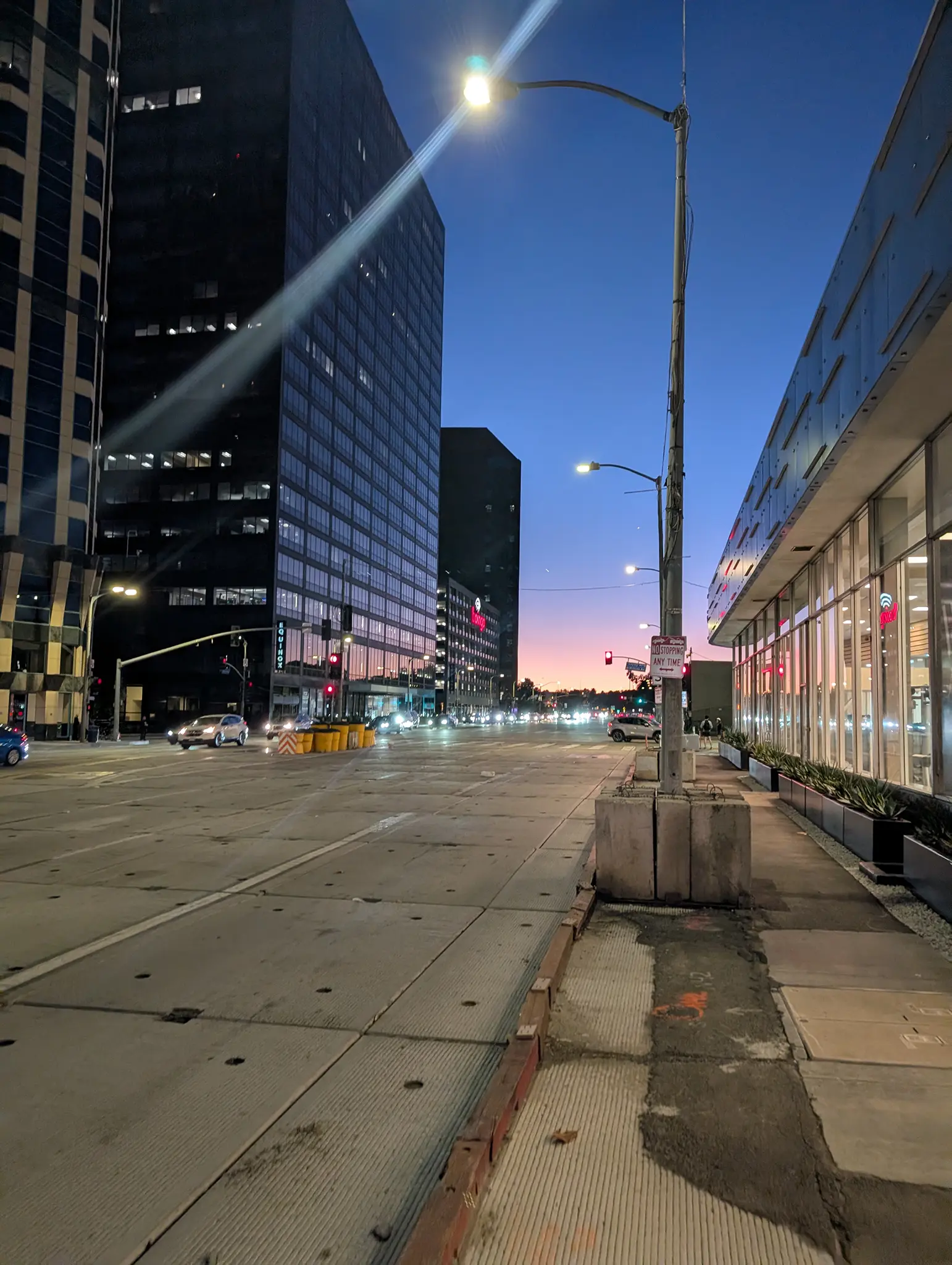
Forsaken even by the sun.
It was after 5PM. The sun whispered residual light in the atmosphere from the other side of the world. We headed toward the nearest bus that could take us closer to home. This would mark only the second time we started a walk but didn’t finish (2023 and now 2025).
Years and If We Finished It:
- ✅ 2010: Wilshire 2010
- ✅ 2011: Hollywood
- ✅ 2012: Melrose
- ✅ 2013: Sunset
- 🚫 2014: Ventura - Did not walk (trip to Australia)
- ✅ 2015: Olympic
- ✅ 2016: Pico 2016
- ✅ 2017: Beverly
- ✅ 2018: 6th St/Koreatown
- 🚫 2019: Pasadena to DTLA - Did not walk (too inconvenient18)
- 🚫 2020: Wilshire 2020 - Did not walk (had a baby)
- 🚫 2021: San Gabriel Mission to DTLA - Did not walk (baby still a bit too tiny)
- ✅ 2022: West Adams to Venice (with the baby!)
- 🚫 2023: Griffith Park to Griffith Park Loop - Did not finish (left early due to the Great Preschool Stomach Plague of 2023)
- ✅ 2024: USC to UCLA
- 🚫 2025: Wilshire 2025 (left early because … )
Ultimately, we left 2025’s Walk for multiple reasons including my wife not feeling well and generally the thought of four more miles (conservatively about 1.5 - 2 hours) didn’t feel like fun anymore. The universe conspired to challenge my need to endure walking in the dark to “earn” the accomplishment. But, instead, we looked onto the 405 from the Culver 6 bus stop and waved goodbye.
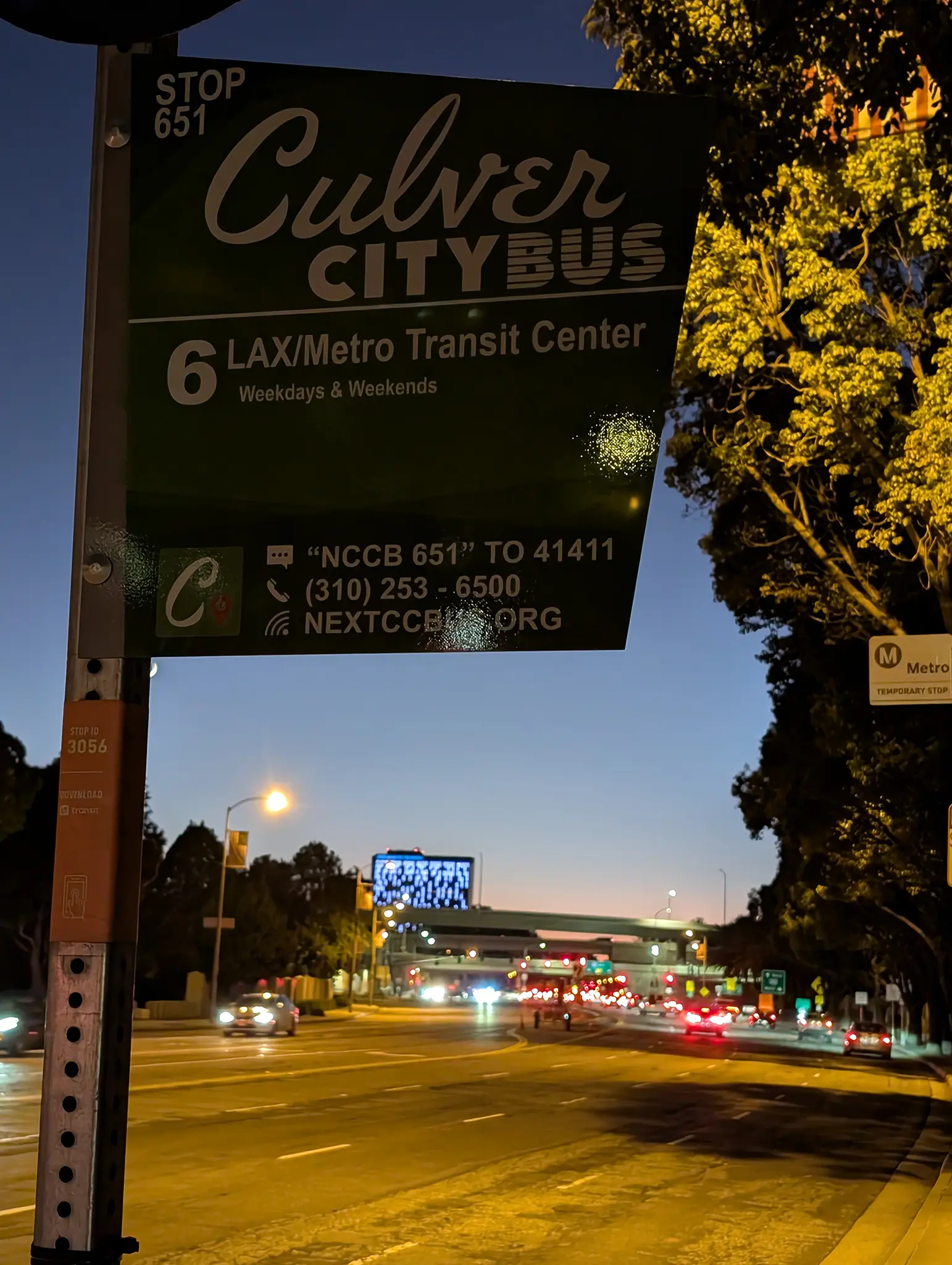
The farthest we pushed that night.
Finding Your Own Finish Line (aka My LinkedIn Post)
Failure is just misplaced expectations.
For anyone curious about this walk, particularly people that aren’t used to endurance journeys or long-range pedestrian activities, I would never tell them they have to reach the end. Bailing is an option. Have fun until you don’t. Enjoy everything.
The reason there’s an end to the Great LA Walk, to me, isn’t to give you a success condition but to give you a reasonable range to explore. Los Angeles is incomprehensibly massive not just in geography but because it contains profound depth in every pocket. Telling someone to walk all of LA and duck into every shop, restaurant, art gallery, or museum along the way, while probably really rewarding, would be irrational. It’s insurmountable, a laughable request, like asking someone to investigate infinity.
For every LA Taco or Eater LA recommendation, there are five holes-in-the-wall or tent pitched on a sidewalk that deserve your attention and five more people running unpermitted bistros or bakeries out of their kitchen who could blow your hair back. Giving you a distance to walk, even if it’s 16 miles in a day, feels difficult but not impossible. You eat the elephant one bite at a time.
The point is to learn about your city from the ground level. And that’s the whole point. That and to realize how everything is connected and that there are no “fly-over” neighborhoods19. But, if you take that task seriously, to explore as you move through the city, you would be excused if you didn’t make it all the way to the ocean by the time your day runs out.
What is your finish line? Is it visiting the list of places you found before you started? Is it going until you just aren’t having fun anymore? The best part about the Walk is that it’s self-directed and no one holds you accountable. No one has an entry form for you. There’s no DNF printed next to your name if you bail. Did you learn something? Did something make you think? Did you feel a sense of wonder at some point along the way? That’s what it’s all about: falling in love with Los Angeles, something that getting to the western edge of Santa Monica isn’t going to take away from you.
Don’t overlook the things you found out about yourself and the city you explored when you didn’t make your goal.
Wilshire is still my favorite route. There’s just too much on Wilshire that matters to me: my history, its history, its connection to everything in this city. I can’t wait to do it all over again in 5 years. Who knows how long it’ll take me, my wife, my father-in-law, and my ten-year old then? Who knows how much more Los Angeles will have waiting for us?
It’s a very cool statue. I don’t know why it sits at the end of Wilshire instead of Santa Monica Boulevard. No one asked me. ↩︎
Some of you parents out there might be wondering why an avowed city mouse did not opt for the Cruiser City. That’s fair. We assessed and found more options are available for pushing or pulling the wagon in the All-Terrain. Also REI didn’t have the Cruiser City available, and, of course, you have to account for the wild caveman in me that thinks I might need to pull a wagon across all-terrain one sweet day. See how that dream fails miserably later. ↩︎
The stereotype about people that run marathons endlessly finding ways to fit that they ran at least one marathon into a conversation is unfortunately not without merit. The end of 2025 probably means I need to cut that out because I can’t say that I ran a marathon “last year” anymore. I also found out from that marathon that running 26.2 miles is not a distance I find fun or enjoyable. ↩︎
I made a website that allowed you to track your journey and get information about things along the way. I’ll talk more about it in a longer case study post (including all the things that went wrong with it and how I fixed them). ↩︎
I did get the nerve to go into the HMS Bounty, which was one of the best early-days-in-LA decisions I made. Sunday afternoons watching sports on a tiny TV, eating the special with a bunch of salty old Angelenos in a nearly-empty establishment, all of whom would rather pass away than talk to me is exactly the bar aesthetic I crave. ↩︎
This place is no longer there. But I remember eating there often not because I loved the place or because I needed to eat pizza but because I needed to have an interaction with a human. I moved to LA to work remote for a company in Atlanta and knew absolutely no one in the city proper. My life in 2010, outside for the occasional greasy slice, felt like I was living 2020 ten years early. ↩︎
By this time we’d spent 30 minutes or so playing at the playground at MacArthur Park and were approaching 30-45 minutes at Open Market. We were naive to the point then but the dream of us getting through Santa Monica by sundown probably died in anticipation of a burrito. ↩︎
I begrudge Eater LA for many petty and nonsensical reasons (reporting tends to not be food criticism so much as it is fluff, they overrepresent the east side and forget major swathes of the city, one time I had an email exchange with the tip line that left me very angry, etc), but I’m glad they led me to Open Market. ↩︎
A friend of ours might have gone too hard hyping up Apollonia's before we went on the walk. It is very good pizza but we also live within walking distance of Little Dynamite who might do an equal if not better square pizza. I liked the space; we got a sticker. Just saying if you’re in the Venice Boulevard Coastal Corridor, might be worth your while to stop by the little pizza shop in Mar Vista. ↩︎
Fun fact: the big lake in front of the La Brea Tar Pits is man-made. It’s a filled-in asphalt mine now featuring familial trauma. ↩︎
As a demonstration of that culture, my profile photo for years featured me standing triumphantly in front of Levitated Mass , though my favorite piece that I’ve seen at LACMA is Magritte’s The Treachery of Images (you know, the pipe one ). I don’t think about the Roman Empire very often but that piece is a core reference for me. ↩︎
The other choice was to play "Down Rodeo" by Rage Against the Machine but I went with the more on-the-nose and light-hearted pick. Even though my hobby right now is to watch people who have never heard Rage Against the Machine before react to it. ↩︎
The John Wayne statue is weird until you realize that the company that used to own the building (Great West Savings & Loan Bank) used to run commercials with ol’ Marion a bunch in the ’70s. It used to actually rotate but it distracted drivers. So, you know, they had to shut it off. Because of the drivers. ↩︎
But things are changing. The Metro D line opens its doors in Wilshire/La Cienega and Wilshire/Rodeo stations in March 2026 . That means heavy rail will finally find its way underneath the begrudging city. It’s a boon for people that stay in downtown on their vacations but want to say they spent money in Beverly Hills. It’ll also be useful for some of the people that work Beverly Hills but could never afford to actually live there. ↩︎
We did, however, stop at the Apple Pan for our tradition of “pies and fries” (slices of apple pie and more fries than we could ever eat). It’s a tradition that started with the 2016 Walk (Pico) that we carry on even today whenever we’re just in the area. I hear they have good burgers, too? ↩︎
I want to point out how much I want to tear into this assumption from city planners that pedestrians don’t even deserve a sign to point out that the thing they are walking on is about to end and that they need to cross. I want to but that is all the next 1000 words would be about. You’ve already hung on for so long into this story. For you, I will show some restraint. ↩︎
Between the 405 and Santa Monica’s San Vicente Boulevard, it’s just government buildings and nothing else. The oldest building on Wilshire is there (Wadsworth Chapel ) and there was sidewalk but it would be an uninteresting slog for people that were already teetering on the edge. ↩︎
Getting from Venice to Pasadena would’ve meant either staying the night in a hotel or a Herculean effort to get there on time in the morning. So, instead, we put on a mini-one for ourselves by gathering a few friends and walking down the length of Venice Blvd from Main Street until we hit sand. The ocean on our bare feet while watching the sun disappear was pretty incredible. ↩︎
Just “fly-over” stretches of Wilshire dominated by rich people or the government or rich people in the government. ↩︎