Jump to a section
Congratulations! You’ve decided that to do the Great LA Walk on Saturday, November 22, 2025! You’ve considered the idea of walking from downtown to the ocean and nodded solemnly in a let’s-do-this fashion to the shock and awe of so many Angelenos who cannot square it. Welcome to the party, pal.
This year’s walk is down Wilshire Boulevard, one of the more storied streets in all of Los Angeles. What does that mean for you? Lots of stuff to see, do, eat, and enjoy as well as a kind of a walk through history as you walk in the same direction as the expansion of Los Angeles for the last 200 years. Of the Great Walks, this is my favorite route because of how much there is along Wilshire Boulevard and how much of LA you get to see from the sidewalk. You’ll go through Westlake, Koreatown, the Miracle Mile, Carthay Square, Hancock Park, Beverly Hills, Westwood, and Santa Monica (plus more!) all in the span of a workday. And you’ll see things you’ve driven by or ignored for years in a brand new light. It’s amazing!
But it’s also an urban hike and, by that, I mean it’s not a walk in the park (although you may walk through several parks). The tough part is that it is a 16.5-mile walk from beginning to end and that’s not nothing. The good news is that you’re surrounded by bathrooms, food places, and a public transportation/gig-economy grid that is ready to get you home whenever you want! Do wonders never cease?
With that, you might want to know some stuff before hopping into the route.
NOTE: This is written with the perspective of people that have preschool age children. If you don't have kids (or are offended by the idea of kids), feel free to roll your eyes at how everyone that has kids just keeps talking about their kids and go to the next thing.
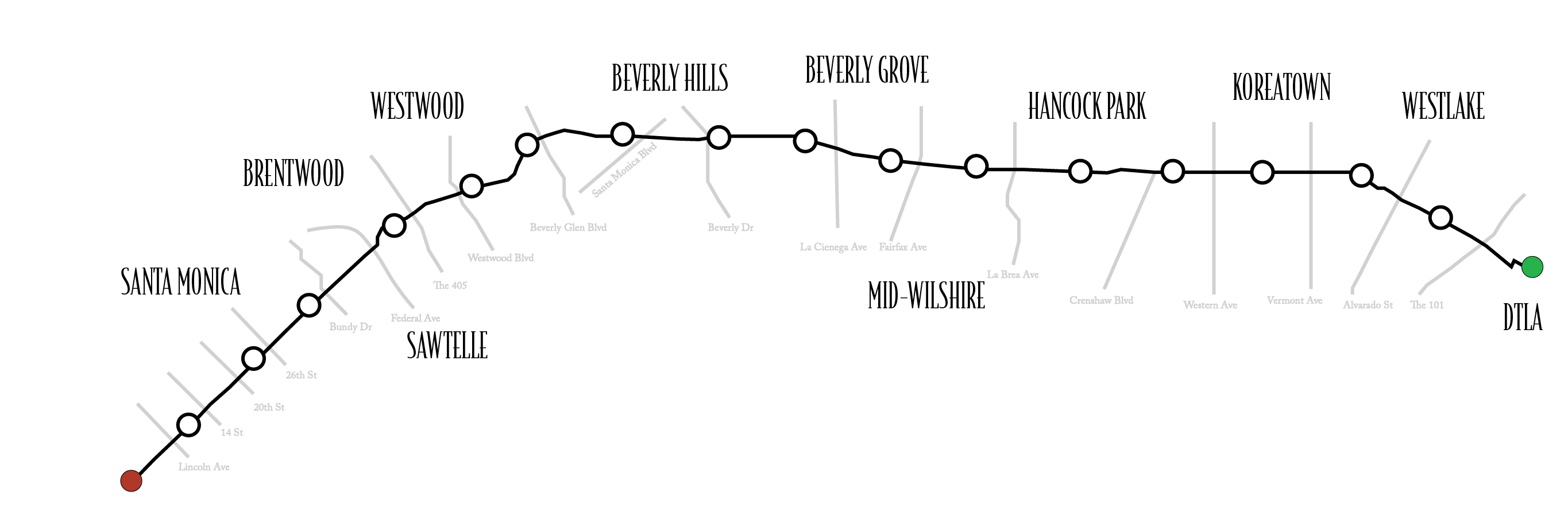
Map of Wilshire with milemarkers, major intersections, and neighborhoods
Tips and Tricks for the Great LA Walk
The Preamble aka How the Walk Works
Michael Schneider (surprisingly not the guy from Streets for All but the media critic/journalist/editor ) has been leading these walks for 20 years. He’s good people and loves Los Angeles, which, again, adds to his being good people. The preamble to each walk amounts to the following:
- The “opening ceremony” (usually a speech about the walk and a guest speaker to talk about what you’ll see along the way) starts at 8:30-9AM-ish followed by a group picture and then we’re off and walking. If you get there late and you don’t see the group of people, don’t worry! Just start walking!
- There’ll be a PDF (available online before the walk) and a print-out (available at the starting area in Pershing Square) that has the route and some interesting sites along the way. The route is pretty easy this year since it starts where Wilshire Boulevard begins in downtown and ends when you see the statue of Saint Monica at the end of Wilshire Boulevard in Santa Monica’s Palisades Park.
- There is nothing official about this walk. You’re on your own to do it however you want to do it. You can stop wherever you want to stop. Be mindful of all the laws. There’s no Great LA Walk organization to sue if something happens to you along the way. This whole thing is just a bunch of people doing the same thing at the same time, loosely organized.
- It’s not a race. There’s no medal at the end. No charity benefits from you finishing.
- There is no wrong way to do this walk. Just start walking with everyone else and walk until you reach the edge of the world. Do you need to quit walking and skip to the end via car, bus, or other travel? Do it. It’s your journey, boo.
Michael also puts up a page of frequently asked questions before each Walk (this is the FAQ for the Wilshire walk ) that details all the need-to-know stuff. But then there’s some advice that we’ve figured out along the way that’s helped us really enjoy the walks.
Don’t bring too much stuff.
Don’t feel like you need to plan for every contingency. You are in the middle of a city, after all. It’s why you live here: you’re surrounded by an abundance of stuff to help you live. The more you bring, the more you have to carry, the more cumbersome it’s going to feel as you walk (and you will feel every ounce on that last mile through Santa Monica). The things we usually take fit into one small backpack:
- Water bottles
- Emergency snacks (for when the hangry gets us)
- Sunscreen
- Wipes (for the spills and accidents) and hand sanitizer (for when soap isn’t around)
- Spare clothes for the kiddos (for spills and accidents)
- Cash for street vendors
- Body Glide or equivalent (the leg connector region of your body will thank you)
- Aforementioned comfortable clothes and comfortable shoes (don’t be a hero in jeans for this one) and layers (it might be chilly in the morning, really hot in the afternoon, cold again as the sun goes down)
- Reusable cutlery and implements (forks, spoons, straws, cups, etc) if you don’t want to create a bunch of trash
- Reusable shopping bags (multi-functional; holds new stuff you bought or old stuff that has been affected by the spills and accidents) that roll up small
- Activities for the kiddos (to distract them during the long stretches where there is not ice cream)
Bonus question: Should I take our wagon/stroller/transport method for the kiddo? Unless you’re planning on making frequent stops for rest, you’re not going to want to carry your kid for hours upon hours, especially if they get bored and power down. We are bringing our wagon on transit. It’s not ideal to pull that bulky thing onto a bus and a train but it’s probably the best thing for our kid and for us. If you have a wagon or stroller that you are comfortable with, I highly encourage you making space to bring it. Napping will be crucial for a younger kiddo to make it farther into the walk. We took our Veer All-Terrain Cruiser with us last year and it handled really well. Also, the police are not going to arrest you if you don’t walk the walk. Do you have a cool cargo bike you’d rather take? Yeah, man. Looking to break out that penny farthing to give it a whirl? Capital! Hang gliders? Tough to get the height you need especially at the beginning since many of the buildings were built at a time when Los Angeles limited building heights to 150-feet but I believe in you.
Make your get-back plan.
The trek is a one-way journey, meaning that you will end very far away from where you started. You’ll need to do some planning for how to get home once you’ve found yourself at the ocean’s end of Wilshire Boulevard.
- If you have a car, my suggestion is to park in downtown Santa Monica early in the morning and then take the E Line train (née the Expo line) from Downtown Santa Monica station (at Colorado and 2nd) back to downtown LA (about an hour ride) for the low-low price of $1.75 per person 6 and older. You can get off at 7th Street/Metro Center Station and walk about 5 blocks (7-10 minute walk) to Pershing Square. You can also ride it to the new Historic Broadway Station which drops you off near Grand Central Market (great for an early morning meal) and walk 10 minutes to Pershing Square from there. Your feet and brain will thank you when you find your car near where you finish your journey.
- Alternatively, you can drive to Pershing Square and park at the garage there (or somewhere in downtown – I don’t know how all-day parking works as I famously begrudge cars). The E line will be waiting for you in Santa Monica to take you all the way back downtown (again, about an hour ride).
- Alternatively alternatively, you can skip the car entirely and take Metro/Big Blue Bus or ride share (Uber has cars with its own car seats) there and back. For the Metro-all-the-way option, I highly recommend adding the Transit app on your phone since it will calculate how to get around for you and tell you where to catch the modes of transport. The TAP app will also be helpful (so you can load a transit pass directly on your phone and tap your phone on the entry points).
Don’t overplan though.
Take some time to see if there’s anything along the way that you’d like to check out but don’t feel like you need to get deep in the weeds. The whole point is to explore, right? The organizer of the event usually puts out a list of stuff he thinks is interesting so you’ll have that in hand to check things out. I also have an evolving spreadsheet of architecture, food, historic, and kid-friendly sites along the Wilshire route. Do I take my own advice? No, of course not. My love language, as my lovely wife tells me, is showing people how to have a good time in LA with comprehensive lists and recs.
Know your kids’ limits.
It’s hard enough to convince adults of walking anywhere let alone alone walking for more than sixteen miles in a single day. But the kids? Hoo boy. The prospect of this is unfathomable to burgeoning imaginations. Take breaks. Find things along the way to get them excited (parks, playgrounds, ice cream, etc). Work in ways for them to take naps or engage with the walk differently (scooters? scavenger hunt? sing-alongs?). We’ve finished two years when our kid was two years-old and four years-old so it’s possible as long at you adjust your goals and your journey. But, all else fails, bail. If it’s becoming an unsolvable drudgery, there’s need to drag your kid another 11 miles after they’ve heroically made their way from Pershing Square to the La Brea Tar Pits. For some kids, getting over the 110 will be a feat of its very own. Also: if your kid gets sick at the very beginning and doesn’t seem to recover, don’t keep telling yourself that it’s car sickness gone haywire. It might just be the Pre-Thanksgiving Preschool Stomach Plague of 2023. Go home.
Be respectful of people.
You are going to be walking through a lot of Los Angeles which means you’re going to see a lot of different walks of life. Knowing you’re in Los Angeles also means you know you’re going to walk past people that are experiencing homelessness and/or abject poverty. Sometimes this can scare those who don’t usually see those things up close. Know that we’ve been doing this for a long time and have never had a problem. Be ready to have conversations with kiddos who may not know what’s going on. Treat people with dignity and respect. You’ll be all right.
The Los Angeles Country Club and Veterans Administration stretches actually suck.
These stretches are boring because there’s nothing for a long time of walking. Wilshire splits the Los Angeles Country Club grounds for about a mile where you’ll see nothing on either side of the street except for high fences and people struggling to golf. For the Veterans Administration district, you’ll cross under the 405 and have about half a mile that will feel barren until you get to Federal/San Vicente1. For the Country Club stretch, your last chance for a potty break or refueling will be at the corner of Wilshire and Santa Monica Blvd in Beverly Hills. For the Veterans Administration stretch, you’ll want to reload in the Westwood Village at the corner of Wilshire and Westwood Blvd.
Streeeeeeeetch Breeeeeeeaks.
Stretch. All the time. You’re going to be walking a long time and then stopping to look at things and then walking and stopping. Your muscles aren’t going to know what’s going on. Stretch often on the journey and stretch at the end and then stretch when you get home/before you go to bed. Whatever you do to keep your calves, quads, hammies, and hips from being lakes of lactic acid, do that. Some suggestions:
During the Walk (quick stretches for when you’re waiting at lights to cross the street):
- Standing Quad Stretch: Stand tall. Grab your left foot/ankle with your left hand and gently pull your heel towards your buttock. Keep your knees close together and hips tucked slightly forward (don’t arch your back). Use a wall/tree for balance if needed. Switch sides.
- Standing Toe Touch (Single Leg): Stand with feet hip-width apart. Shift your weight slightly to your right leg. Straighten your left leg, putting the heel on the ground and pointing the toes up. Hinge at the hips, keeping your back straight, until you feel a gentle stretch in the back of the left thigh. Switch sides.
- Calf Wall Stretch: Face a wall. Step your right foot back about 2-3 feet. Keep your back heel firmly on the ground and your toes pointing forward. Lean forward into the wall until you feel a stretch in the lower leg/calf. Switch sides.
- Ankle Circles: Stand on one leg (use support if needed). Lift the other foot slightly and rotate the ankle in slow, controlled circles (10 in each direction). Switch legs.
- Toe Lifts/Curls: Stand normally. Lift all 10 toes off the ground and spread them wide. Hold for a moment. Then, curl them tightly, “gripping” the ground. Repeat 5-10 times.
After the Walk (longer holds to make sure you don’t wake up so sore in the morning):
- Supine Figure-Four: Lie on your back, knees bent, feet flat. Cross your right ankle over your left thigh (just above the knee). Reach through the opening and gently pull the left thigh toward your chest. Feel the stretch in the outer right hip/glute. Switch sides.
- Downward-Facing Dog: Start on hands and knees. Lift your hips up and back, forming an inverted ‘V’ shape. Straighten your legs as much as comfortable. You can “pedal” your feet by bending one knee then the other to alternate stretching the calves and hamstrings.
- Low Lunge: Start in a lunge position with the right foot forward and the left knee lowered to the ground. Ensure the right knee is over the ankle. Gently slide the left knee back a little further to deepen the stretch in the left hip flexor/quad. Switch sides.
- Bound Angle Pose: Sit on the floor. Bring the soles of your feet together and let your knees fall out to the sides. Sit tall and optionally gently fold forward from your hips for a deeper inner thigh (adductor) stretch.
- Seated Toe Extension/Flexion: Sit down. Extend one leg and pull your foot back towards your shin (flex). Then, point your toes forward (extend). You can also use a strap or towel looped around the ball of your foot to gently pull the toes toward you for a deeper stretch.
Be curious.
The whole point is to see and do things in places that you might otherwise ignore. Eat that food that you’ve always wondered about. Poke your head into a building that you’ve seen from the outside a thousand times and always wondered what it looks like on the inside. Buy stuff from the small businesses along the way. It’s not a race so take your time looking through things. Take the 99% Invisible approach and read the plaques. Look at them as milemarkers and things to get amped about. You’re about to learn something. How cool is that?
Be a tourist.
This is your chance to be a tourist in your own city in a way that doesn’t mean you have to hop on a bus to see Jimmy Kimmel’s house. Check out the street art. Take pictures of street signs. Treat this the same way you might if you were in Madrid or Helsinki or Tokyo. Bask in the joy of doing something weird. Marathoners don’t often have the time and wherewithal to take pictures of themselves doing something incredible. Be proud of what you’re doing and the endurance you are mustering to do it.
This is a different San Vicente Boulevard than the one you crossed six miles before. It’s also not the same street. I don’t know why this is legal. I wanted to say that Brentwood/Santa Monica didn’t feel the other San Vicente Blvd honored Saint Vicent enough so they made their own and put an A.O.C. on it. But it turns out this one (on the Westside) is older and the other one (in Central LA) was meant to probably connect to the original street at some point. But no one, like, discused it before they started building and naming it? Shatteringly appropos of modern Los Angeles. ↩︎